

Introduction
The cable nightmare in your kitchen is about to disappear. At CES 2026, multiple companies unveiled Long-Range Wireless Charging for Gadgets systems capable of powering blenders, coffee makers, and toasters without any physical connection. WARP Solution demonstrated RF-based wireless power transmission reaching up to six meters, while Kitchenery showcased Ki wireless standard appliances delivering up to 2,200W through magnetic induction—enough to run a high-powered blender or air fryer completely cordless.
For homeowners drowning in countertop cable clutter, this matters because the Wireless Power Consortium’s Ki Cordless Kitchen standard transitioned from concept to “credible infrastructure-level solution” at CES 2026, with major kitchen appliance manufacturers committing to adoption. Companies like COSPRO announced Best Buy retail availability for wireless-charging kitchen systems, signaling that Long-Range Wireless Charging for Gadgets has moved beyond prototype demonstrations to genuine consumer products you can purchase in 2026. The wireless charging system for kitchen appliances market is experiencing rapid growth as industry leaders including Qualcomm, Energous, and Renesas develop RF-based and magnetic resonance solutions specifically designed for home environments.
The CES 2026 Wireless Power Breakthrough
RF-Based Long-Distance Charging
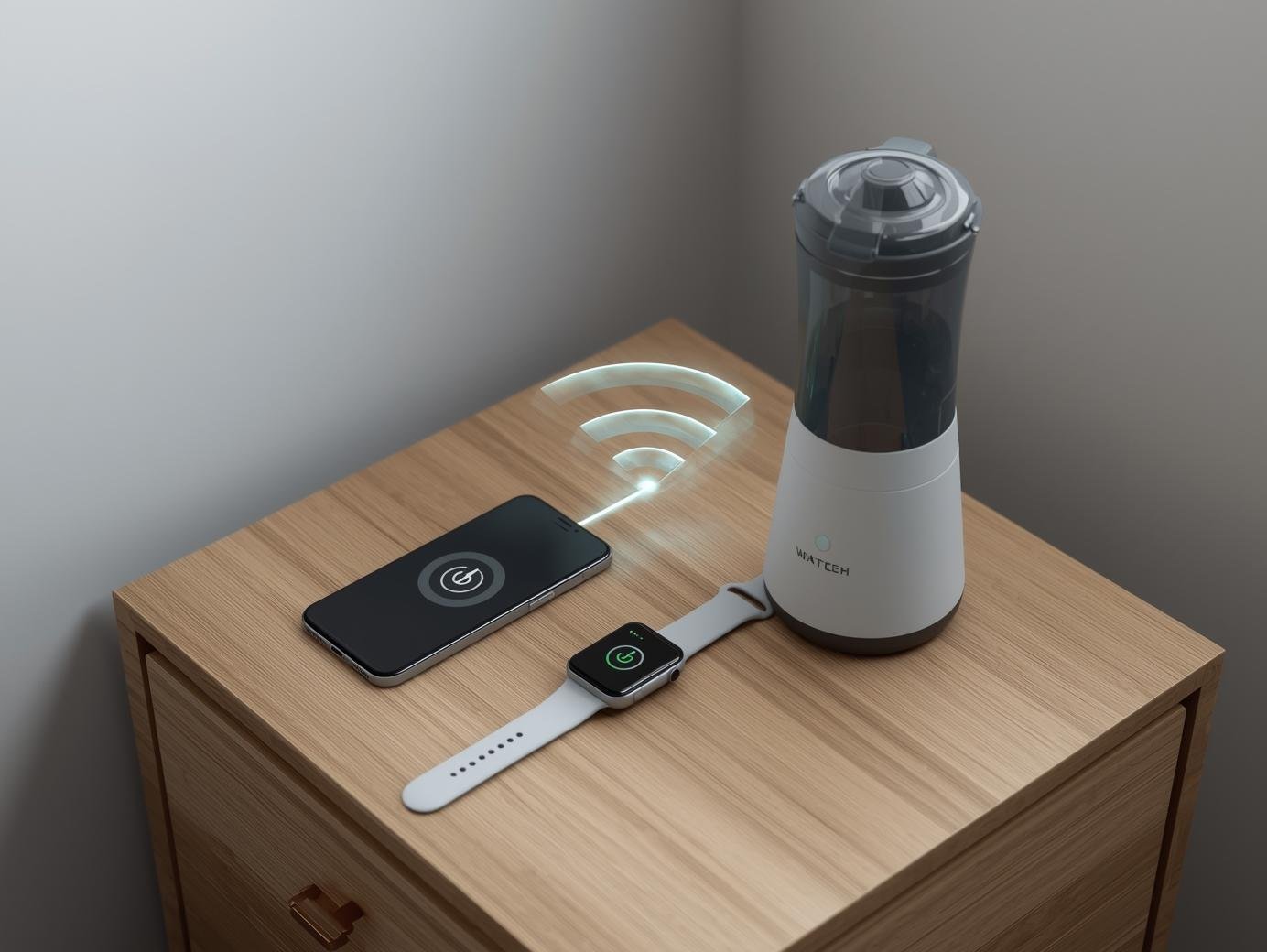
WARP Solution’s CES 2026 demonstration showcased what they call “Energy Wi-Fi”—a system that transmits power through radio frequency waves using specialized antennas rather than traditional near-field induction. Under optimal conditions, WARP’s technology delivers power at distances up to six meters, fundamentally changing where devices can be powered. Their proprietary WEP chips maintain up to 60% energy efficiency even under fluctuating transmission conditions, delivering 3 watts of power—15 times more than competing solutions that require multiple components.
The system combines AI tracking with adaptive beam-forming to follow devices as they move within the coverage zone. Unlike Qi wireless charging that requires millimeter-precise placement on a pad, Long-Range Wireless Charging for Gadgets using RF technology enables continuous charging simply by being within range. WARP envisions applications including an “energy box” that powers toys or professional accessories continuously, and AA battery form factors with integrated RF charging designed to replace disposable batteries in existing devices.
Sensors, wearables, smart home devices, and industrial electronics no longer need tethering to outlets or routine battery replacement service. The technology positions wireless power as invisible background infrastructure rather than a task users constantly manage.
Ki Wireless Standard: High-Power Kitchen Applications
The Wireless Power Consortium’s Ki standard addresses high-power appliances specifically, enabling wireless power delivery up to 2,200W through magnetic induction—drastically exceeding Qi’s consumer electronics focus. At CES 2026, Kitchenery demonstrated Ki-enabled cordless kitchen appliances showing how wireless power enhances both safety and aesthetics in everyday environments.
Kitchenery’s patented wireless power transfer technology uses special coils embedded in countertops that send magnetic frequencies to receiving pads installed underneath small kitchen appliances. Whenever an appliance is placed on the “smart pad” countertop, it powers without cords—similar to how wireless charging pads power cell phones but scaled to kitchen appliance wattage requirements. The coils don’t react to or interact with foreign objects and are considered safe technology for powering consumer electrical devices.
CES 2026 spotlighted a major shift toward truly cordless kitchen environments, with Long-Range Wireless Charging for Gadgets powered by Ki wireless transfer becoming the new norm. COSPRO showcased its progression from single grinders to 5-in-1 systems at CES 2026, demonstrating how wireless charging transforms modern kitchens after launching in Best Buy stores.
Etherdyne’s Wireless Power Zone
Etherdyne Technologies (ETI) unveiled a groundbreaking wireless power zone at CES 2026 featuring a truly cord-free desk setup—powering a laptop at up to 50 watts, smartphone charger, and computer peripherals simultaneously without cables or battery swaps. Unlike traditional wireless charging limited to fixed spots, ETI’s low-frequency magnetic resonance technology delivers continuous, position-free power to multiple devices at once within a shared space.
The platform supports simultaneous wireless power delivery to devices with varying energy needs, offering true freedom of movement and scalability. It’s positioned as a game-changer for workstations, retail environments, and smart homes. ETI’s 6.78 MHz magnetic resonance architecture delivers up to 100 watts of power safely and efficiently—not science fiction but technology ready for real-world integration in 2026.
How Long-Range Wireless Charging Actually Works
RF Energy Transmission Technology
Long-Range Wireless Charging for Gadgets using RF technology transmits power through the air similar to how Wi-Fi transmits data. A transmitter sends RF energy that a receiver chip inside the device converts into power to charge the battery or run the device directly. This method enables charging from a distance without requiring cables, wireless charging pads, or precise alignment.
RF-based Long-Range Wireless Charging for Gadgets works particularly well for low to medium power applications including sensors, wearables, and IoT devices. The technology ensures continuous operation without manual charging—ideal for large spaces like warehouses, hospitals, factories, and increasingly, residential homes. Devices automatically charge when within range of transmitters and stop when fully charged or moved out of range.
Companies like Energous pioneer wireless power-at-a-distance technologies using RF-based charging systems that eliminate coil alignment constraints. Their solutions suit kitchen environments requiring unobtrusive, hygienic surfaces, with proactive regulatory approval approaches accelerating commercial readiness.
Magnetic Resonance and Induction Systems
Magnetic resonance technology creates localized charging zones within furniture or surfaces, enabling multiple devices to charge simultaneously. Unlike RF systems optimized for long distances with lower power, magnetic resonance delivers higher wattage over shorter ranges—typically under two meters. This makes magnetic resonance ideal for countertop and desk applications where devices remain in relatively fixed positions.
High-power inductive solutions rapidly energize larger equipment like robots or kitchen appliances. Powercast demonstrated three distinct approaches at CES 2026: RF for low energy over distance to small sensors, magnetic resonance for localized charging zones, and high-power induction for larger equipment. This portfolio addresses limitations imposed by traditional batteries and physical connectors that hinder reliability, increase maintenance, and restrict design possibilities.
The Ki standard’s magnetic induction approach embeds transmitter coils directly into countertops, creating invisible charging zones that activate when compatible appliances are placed above. This infrastructure-level integration represents the future of smart home design where power becomes environmental rather than device-specific.
IoT Integration and Smart Management
IoT-enabled Long-Range Wireless Charging for Gadgets adds intelligence to wireless power systems. Businesses and homeowners can track which devices are charging, monitor power consumption in real-time, and optimize when to stop charging. This ensures devices remain ready for use while saving energy and reducing waste.
Smart charging with IoT integration reduces downtime by ensuring equipment remains powered without interruption—critical for logistics, healthcare, and increasingly, smart home environments where continuous device operation is expected. The technology reduces need for disposable batteries and lowers wear on cables, cutting costs while supporting sustainability goals.
Expert Analysis: Is Wireless Power Ready for Your Kitchen?
The Power Output Reality Check
Long-Range Wireless Charging for Gadgets in 2026 spans a dramatic power range depending on technology. RF-based systems like WARP Solution deliver 0.2-3 watts suitable for sensors, remotes, and small electronics. Magnetic resonance systems provide 50-100 watts adequate for laptops, tablets, and larger consumer devices. High-power induction via the Ki standard reaches 2,200 watts—sufficient for blenders, coffee makers, toasters, and air fryers.
This power spectrum means different wireless charging technologies target different use cases. Small countertop gadgets like electric whisks, milk frothers, and cordless hand mixers benefit from medium-power magnetic resonance systems. Full-size appliances including high-speed blenders and food processors require Ki induction infrastructure. Understanding which technology matches your devices determines whether Long-Range Wireless Charging for Gadgets makes practical sense for your specific kitchen.
For homeowners, the sweet spot appears to be magnetic resonance systems delivering 50-100 watts to multiple small appliances simultaneously, combined with Ki induction zones for high-power devices. This hybrid approach eliminates the majority of kitchen cables while remaining cost-effective.
Installation and Infrastructure Considerations
Adopting Long-Range Wireless Charging for Gadgets for kitchens requires infrastructure investment. Kitchenery’s countertop-embedded coil system necessitates either new countertop installation or retrofit installation beneath existing surfaces. This positions wireless power as a feature for kitchen renovations or new construction rather than simple plug-and-play upgrades.
However, companies like Renesas emphasize compact, efficient charging modules designed for both retrofit and built-in kitchen applications. Their solutions minimize electromagnetic interference and ensure safety compliance with evolving regulatory standards, supporting faster integration across appliance formats. The market is developing solutions at multiple price points and complexity levels to accommodate different adoption scenarios.
RF-based systems like WARP Solution offer simpler installation—wall-mounted transmitters create charging zones without infrastructure modifications. This approach works well for renters or homeowners seeking wireless charging benefits without permanent modifications.
Cost vs. Convenience Analysis
Current Long-Range Wireless Charging for Gadgets systems command premium pricing. Kitchenery’s cordless kitchen system costs significantly more than traditional appliances and standard countertops. WARP Solution hasn’t announced consumer pricing, but early RF charging systems typically cost $200-500 for transmitters plus device-specific receivers.
The value proposition centers on convenience, safety, and aesthetics rather than cost savings. Eliminating countertop cable clutter, reducing water-electricity contact risks, and enabling completely clean countertops justifies premium pricing for design-conscious homeowners. As Qualcomm, Renesas, and other major manufacturers scale production, costs should decline significantly by 2027-2028.
Early adopters at CES 2026 expressed enthusiasm for cordless kitchens despite higher costs, suggesting strong market demand exists at premium price points. Mass-market adoption will require prices approaching conventional appliance costs—likely 3-5 years away as manufacturing volumes increase.
For comprehensive reviews of wireless charging systems across power levels and price ranges, visit our [Product Reviews page] where we test RF, magnetic resonance, and induction solutions for real-world kitchen performance.
Safety and Efficiency Improvements
Wireless charging trends in 2025-2026 brought significant safety improvements including foreign object detection and enhanced heat control. These advances ensure Long-Range Wireless Charging for Gadgets systems don’t activate when non-compatible objects are present, preventing overheating or energy waste. Kitchenery specifically emphasizes that their coils don’t react to foreign objects, addressing safety concerns about countertop-embedded power transmission.
Efficiency improvements reduce energy waste during wireless transmission. WARP Solution’s 60% efficiency represents leading-edge performance for RF systems, while magnetic resonance typically achieves 70-85% efficiency—closer to wired charging. The Ki standard’s high-power induction maintains similar efficiency to traditional induction cooktops, making it practical for kitchen appliances.
Integration into consumer electronics continues expanding, making wireless charging easier to use and more accessible. This trend benefits Long-Range Wireless Charging for Gadgets as receiver chips become cheaper, smaller, and more power-efficient.
Key Takeaways: What You Need to Know
- Long-Range Wireless Charging for Gadgets transitioned from prototype to commercial availability at CES 2026, with companies like COSPRO launching retail products at Best Buy and Kitchenery demonstrating Ki-standard cordless kitchen appliances
- RF-based systems like WARP Solution deliver power up to six meters at 0.2-3 watts for small devices, while magnetic resonance provides 50-100 watts over shorter ranges for laptops and medium gadgets
- The Ki wireless standard enables high-power kitchen appliances up to 2,200W through countertop-embedded induction coils, powering blenders, coffee makers, and air fryers completely cord-free
- Etherdyne’s wireless power zone demonstrated simultaneous charging of multiple devices (laptop at 50W, phone, peripherals) without position constraints using magnetic resonance technology
- IoT integration enables smart power management tracking which devices charge, monitoring consumption, and optimizing energy usage for sustainability
- Infrastructure investment required: countertop-embedded systems need installation during renovations, while RF wall-mounted transmitters offer simpler retrofit options
The Cable-Free Kitchen Revolution
Long-Range Wireless Charging for Gadgets crossed the threshold from experimental technology to commercially available products in 2026. CES demonstrations from WARP Solution, Kitchenery, ETI, and others proved that RF transmission, magnetic resonance, and high-power induction can deliver practical, safe, efficient wireless power for home environments.
The technology bifurcates into two adoption paths: premium early adopters investing in infrastructure-integrated systems during kitchen renovations, and mainstream consumers adding RF or magnetic resonance charging zones without permanent modifications. Both paths eliminate cable clutter, enhance kitchen safety by separating water from electrical connections, and enable cleaner, more aesthetic living spaces.
The wireless power market is accelerating rapidly as major semiconductor and appliance manufacturers commit development resources. The question isn’t whether cordless kitchens will become standard—it’s how quickly costs decline to mass-market price points and which wireless charging technology (RF, magnetic resonance, or induction) becomes the dominant residential standard.
Your kitchen in 2030 will likely feature some form of Long-Range Wireless Charging for Gadgets—whether through countertop-embedded Ki induction zones, wall-mounted RF transmitters, or furniture-integrated magnetic resonance charging. The cable-free home is no longer science fiction; it’s an engineering reality arriving in retail stores throughout 2026.
Would you invest in wireless charging infrastructure for your kitchen? Which technology—RF long-range, magnetic resonance zones, or countertop induction—appeals most for your home? Share your thoughts on the cable-free kitchen revolution in the comments below.
Ready to upgrade every corner of your home? From cozy seating like this Furlide chair to high-tech kitchen gadgets, we’ve got you covered. Check out our Full Library of Home Product Reviews to discover more expert-tested gear for your lifestyle.