

Introduction
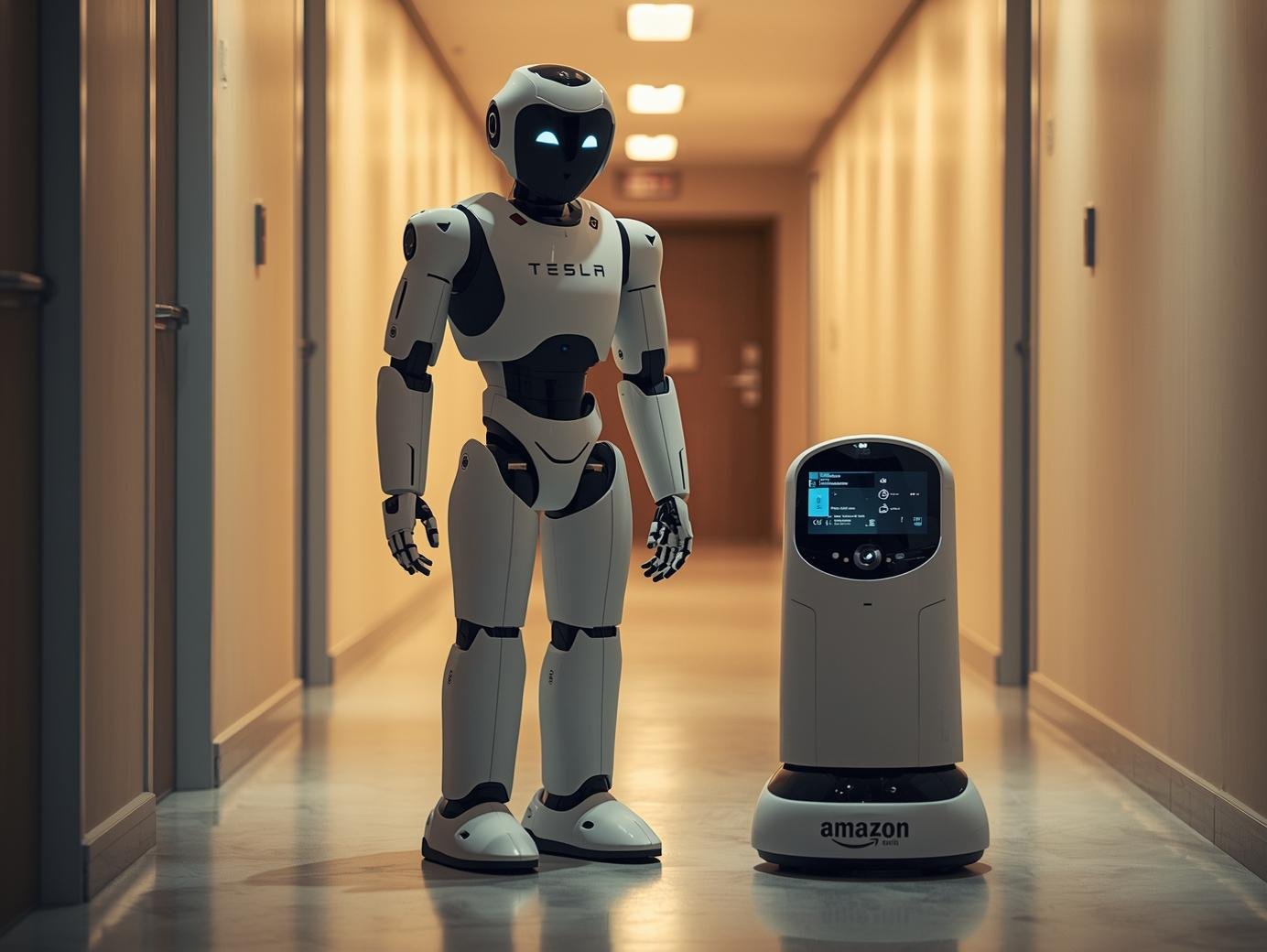
The home robot revolution is here, and two tech giants are battling for dominance in your living room. Tesla CEO Elon Musk announced at the January 2026 World Economic Forum that Optimus humanoid robots could reach consumer markets by late 2027, with limited external sales targeted for late 2026 at $25,000-$30,000. Meanwhile, Amazon doubled down on its home robotics strategy by discontinuing Astro for Business in July 2024 to focus exclusively on refining the consumer Astro experience, signaling a major push for household adoption in 2026.
For homeowners considering smart home investments, this matters because the Tesla Optimus vs Amazon Astro 2026 competition represents fundamentally different visions of home automation. Optimus promises a full-scale humanoid assistant capable of folding laundry, cooking meals, and performing complex household tasks using 22-degree-of-freedom hands and Tesla’s FSD-derived AI. Astro offers a mobile security and companion robot with advanced navigation, Ring camera integration, and visual ID recognition at a more accessible $1,600 price point. The winner will define how millions of homes integrate robotics over the next decade.
Table of Contents
Tesla Optimus Gen 2: The Humanoid Home Assistant
Current Capabilities and Factory Deployment
Tesla Optimus Gen 2, unveiled in December 2023, has been deployed internally at Tesla’s Fremont and Austin factories since mid-2024, performing battery cell sorting, parts handling, and quality inspection tasks. The Gen 2 model features a 10 kg weight reduction compared to Gen 1, 30% faster walking speed (approximately 5 km/h), and redesigned hands with 11 degrees of freedom—upgraded to 22 DoF in the Gen 3 hand configuration released in 2024.
The robot stands at human height, can carry 45 lbs (20 kg), and uses Tesla-designed actuators throughout its body including a 2-DoF actuated neck and articulated toe sections with human foot geometry. Its AI system adapts Tesla’s Full Self-Driving neural network for manipulation, navigation, and object recognition, leveraging 8 cameras inherited from Autopilot technology plus IMU and force/torque sensors in the hands.
Videos demonstrate Optimus performing diverse tasks including mopping floors, taking blood pressure, moving boxes downstairs, preparing pizza, and even assembling robot components. These demonstrations validate that Tesla Optimus vs Amazon Astro 2026 isn’t comparing equivalent products—Optimus targets full household task automation while Astro focuses on monitoring and companionship.
Consumer Timeline and Pricing Strategy
As of February 2026, Optimus remains unavailable for consumer purchase, with internal factory deployment continuing. Tesla targets limited external sales to select partners in late 2026 at an estimated initial price of $25,000-$30,000, with broader commercial availability planned for 2027. Musk’s January 2026 announcement at Davos confirmed consumer sales could begin by the end of 2027, representing one of his clearest public timelines for the humanoid robot.
The long-term pricing goal aims for under $20,000 by 2028-2029, with Musk envisioning “millions of units” produced by 2029. Industry experts note that realistic hurdles like scaling AI for unpredictable household environments and achieving sub-$20,000 manufacturing costs might push widespread adoption to the mid-2030s. However, the trajectory shows Tesla prioritizing factory deployment to refine capabilities before home rollout—a strategy that builds real-world performance data rather than rushing to market.
Leadership Changes and Development Challenges
In June 2025, Tesla’s Optimus program experienced major leadership upheaval when Milan Kovac resigned and was replaced by Ashok Elluswamy, Tesla’s Autopilot lead. This transition signals Tesla’s bet that autonomous navigation AI developed for vehicles translates directly to humanoid robotics—a controversial but potentially transformative approach.
French tech media reported in February 2026 that Optimus faces development challenges, with a new version expected to debut in Q1 2026. These obstacles reflect the immense technical complexity of creating general-purpose humanoid robots that can safely operate in unpredictable home environments.
Amazon Astro: The Mobile Home Companion
Core Functionality and Current State
Amazon Astro, launched in September 2021 as part of the Day 1 Editions program, is priced at $1,599 and designed for homes up to 3,500 square feet. Unlike Tesla’s humanoid approach, Astro uses a wheeled platform equipped with Intelligent Motion technology that employs simultaneous localization and mapping (SLAM) to navigate autonomously around dynamic home environments.
The robot features Visual ID computer vision that lets household members teach Astro to recognize them for personalized reminders, calls to specific people, and item delivery using Astro’s onboard cargo bin. It integrates with Amazon’s Ring cameras for home monitoring, can display video feeds, play music, send reminders, and patrol for unexpected persons or alarm sounds.
Unlike robots that vacuum, Astro focuses on security, monitoring, and companionship. The robot can detect cats and dogs in the home to monitor pets while owners are away, and even dances on command. Astro’s “body language” and awareness of social norms help it interact naturally with humans—controlling speed, acceleration, and path curvature to move safely and gracefully through homes.
Strategic Pivot to Consumer Focus
Amazon’s July 2024 decision to discontinue Astro for Business—refunding all $2,400 purchases plus $300 credits—represented a strategic pivot toward home robotics. In an internal email, Amazon’s engineering president stated he is “increasingly convinced” that advancements in home robotics should be the priority for resource allocation.
This strategic shift suggests Amazon recognized that the consumer home market—not small business security—represents the winning application for mobile robots. However, as of 2024-2025, Amazon has announced no major Astro updates, new features, or redesigned models, raising questions about development velocity compared to competitors like Tesla.
The Competition Landscape: Beyond the Two Giants
CES 2026 Humanoid Robot Explosion
The Tesla Optimus vs Amazon Astro 2026 comparison exists within a rapidly expanding competitive landscape. At CES 2026, multiple companies unveiled home robots challenging both leaders. LG showcased CLOiD, a domestic robot equipped with capabilities for laundry, cooking, and unloading dishwashers using AI and vision technology integrated with LG’s ThinQ ecosystem.
SwitchBot introduced the Onero H1 humanoid household robot, described as “the most user-friendly AI household robot,” designed to orchestrate task-specific devices including robot vacuums and air purifiers rather than performing all tasks independently. The Neo Gamma robot, priced at $20,000 with deliveries expected in late 2026, is being called “closest to getting into the home” by robotics experts.
These competitors demonstrate that Tesla Optimus vs Amazon Astro 2026 isn’t a two-horse race—it’s a crowded field with diverse approaches ranging from humanoid task performers to mobile orchestrators coordinating smart home ecosystems.
Pricing and Market Positioning
The 2026 home robot market segments into distinct price tiers. Basic cleaning robots like Roomba models price around $1,400. Companion and monitoring robots including Enabot and Astro range from $1,000-$5,000. Entry-level humanoid robots like Optimus and Neo target $20,000-$30,000, while industrial humanoids reach $150,000.
This pricing structure positions Tesla Optimus vs Amazon Astro 2026 as fundamentally non-competing products addressing different market segments and use cases. Astro targets mass-market adoption with modest capabilities at consumer-friendly prices. Optimus pursues early adopters willing to invest in transformative full-service home automation.
Expert Analysis: Which Robot Fits Your Home?
The Task Capability Gap
The most significant difference in Tesla Optimus vs Amazon Astro 2026 lies in manipulation versus monitoring capabilities. Optimus’s 22-degree-of-freedom hands with tactile feedback enable it to grasp objects, manipulate tools, and perform complex manual tasks that Gen 1 couldn’t attempt. This positions Optimus as a genuine household assistant capable of cooking, cleaning, and physical labor.
Astro lacks manipulation capabilities entirely—it can’t pick up objects beyond transporting items in its cargo bin when humans load them. Its value proposition centers on mobility, monitoring, and social interaction rather than task execution. For homeowners seeking physical assistance with chores, Astro fundamentally cannot compete with humanoid alternatives.
However, Astro’s focused feature set enables immediate reliability and safety certification that humanoid robots struggle to achieve. A wheeled monitoring robot navigating predictable paths poses fewer safety risks than a 45-pound humanoid moving at 5 mph while carrying objects.
AI Integration and Learning Capabilities
Tesla’s deployment strategy—using Optimus in factories for extended testing before home release—builds massive real-world training data for its FSD-derived neural networks. This approach mirrors Tesla’s vehicle autonomy development, where millions of miles of human driving data trained AI systems to handle edge cases.
Astro’s AI focuses on navigation, visual ID, and human-robot interaction rather than task learning. While sophisticated for its purpose, Astro isn’t designed to learn new physical tasks through experience like humanoid platforms. The trade-off: Astro works reliably within its defined capabilities today, while Optimus promises expanding functionality through continuous learning.
For detailed comparisons of home robots across all price ranges and capability levels, visit our [Product Reviews page] where we evaluate navigation accuracy, AI responsiveness, and real-world task performance.
Smart Home Ecosystem Integration
Astro’s deep integration with Amazon’s ecosystem—Alexa voice control, Ring camera feeds, and Amazon services—creates seamless functionality for existing Amazon users. This closed ecosystem approach simplifies setup but limits flexibility for households using Google, Apple, or other platforms.
Tesla hasn’t detailed Optimus’s smart home integration strategy, though its FSD-derived AI suggests potential for platform-agnostic learning and adaptation. Competitors like SwitchBot’s Onero H1 and LG’s CLOiD explicitly position themselves as orchestrators coordinating multiple smart home devices, suggesting a hybrid approach may prove most successful.
The 2027-2030 Adoption Timeline
Realistic assessment of Tesla Optimus vs Amazon Astro 2026 must acknowledge that neither robot currently delivers on the full “household assistant” vision. Astro is available now but offers limited functionality. Optimus demonstrates impressive capabilities but won’t reach most consumers until 2027-2030 at the earliest.
Early adopters willing to invest $20,000-$30,000 can access first-generation humanoid robots in late 2026, accepting beta-tester status for cutting-edge technology. Mass-market consumers seeking reliable functionality at accessible prices should wait until 2028-2030 when second and third-generation robots address early design flaws and manufacturing scale drives prices below $15,000.
Key Takeaways: What You Need to Know
- Tesla Optimus vs Amazon Astro 2026 represents fundamentally different robot categories: humanoid task performer ($25,000-$30,000, late 2026 limited release) versus wheeled monitoring companion ($1,600, available now)
- Optimus features 22-degree-of-freedom hands, 45 lb payload capacity, 5 km/h walking speed, and Tesla FSD-derived AI enabling complex household tasks like cooking, cleaning, and manual labor
- Amazon Astro excels at home monitoring, Ring camera integration, visual ID recognition, and social interaction, but lacks manipulation capabilities for physical tasks
- CES 2026 showcased multiple competitors including LG’s CLOiD, SwitchBot’s Onero H1, and Neo Gamma, proving home robotics is a crowded field beyond the two tech giants
- Tesla’s factory deployment strategy builds real-world training data before consumer release, while Amazon’s strategic pivot from business to home focus signals belief in the consumer market
- Realistic widespread adoption timeline: Astro-class robots are ready now for early adopters; humanoid robots like Optimus won’t reach mass-market price points ($15,000-$20,000) until 2028-2030
The Robot That Fits Your Timeline
Tesla Optimus vs Amazon Astro 2026 isn’t a winner-take-all competition—it’s a choice between immediate limited functionality and future transformative capability. Homeowners seeking home monitoring, pet observation, and mobile companionship can adopt Astro today at consumer-friendly prices. Those willing to wait 1-4 years and invest significantly more can access humanoid robots capable of genuine household labor.
The broader lesson: home robotics in 2026 has graduated from science fiction to commercially available reality, but the technology remains in early adoption phases. First-generation products will disappoint perfectionists while delighting early adopters. By 2030, refined second and third generations will deliver the seamless household assistance that current prototypes promise but don’t quite achieve.
The robot revolution won’t arrive in a single breakthrough moment—it’s unfolding gradually as competing technologies, form factors, and price points target different household needs and budgets. Your perfect robot depends entirely on which tasks you need automated and how much you’re willing to invest to get there.
Which approach appeals more: Astro’s monitoring and companionship today, or Optimus’s full-service assistance in 2027-2030? Would you be an early adopter at $25,000, or wait for mass-market pricing? Share your home robot strategy in the comments below.
Ready to upgrade every corner of your home? From cozy seating like this Furlide chair to high-tech kitchen gadgets, we’ve got you covered. Check out our Full Library of Home Product Reviews to discover more expert-tested gear for your lifestyle.