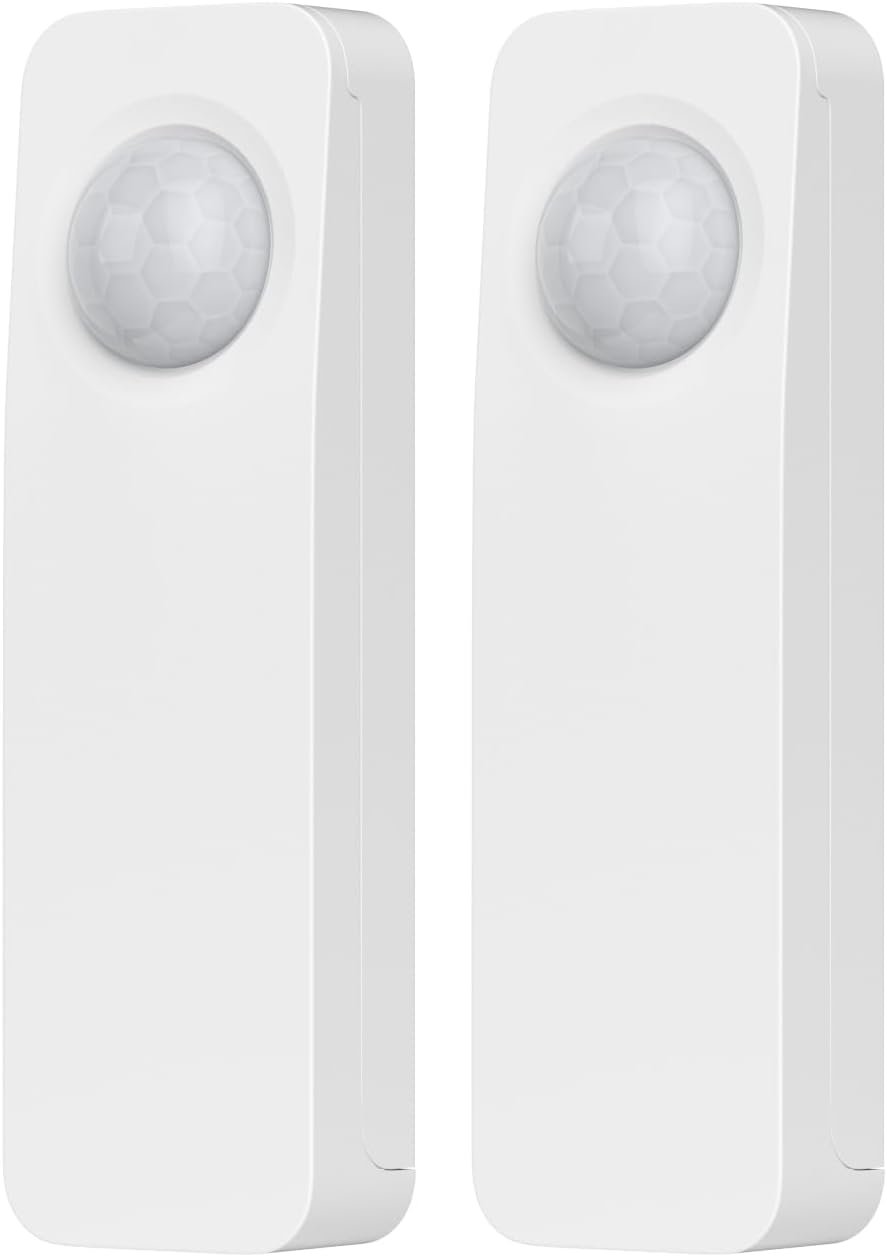


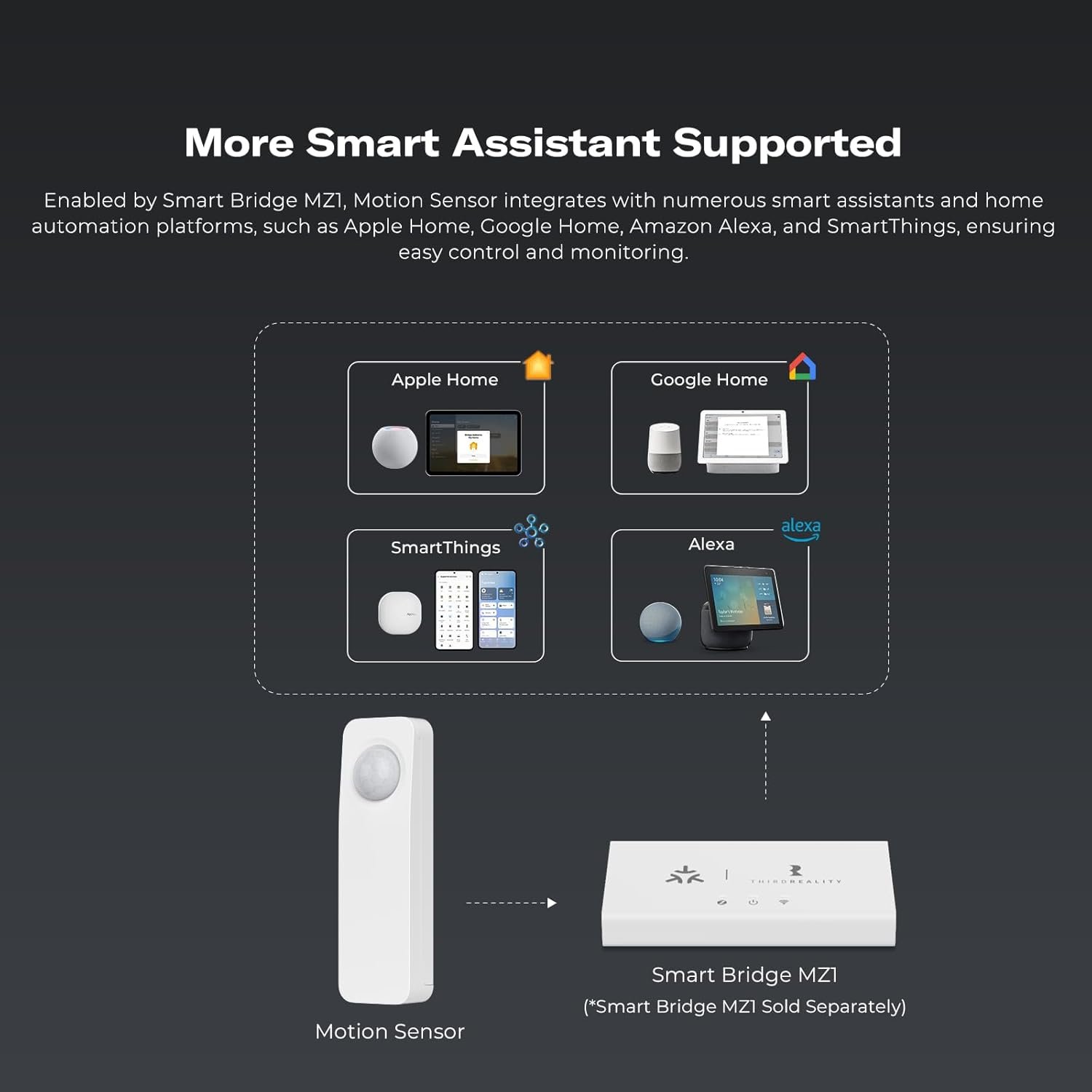

The THIRDREALITY Zigbee Motion Sensor is a compact, reliable PIR (passive infrared) motion detector designed for smart home enthusiasts, Home Assistant users, security-conscious homeowners, and anyone building Zigbee-based automation systems. This 2-pack of sensors integrates natively with virtually every major Zigbee ecosystem—including Home Assistant, SmartThings, Aeotec, Homey, Hubitat, and any Amazon Echo device with a built-in Zigbee hub—without requiring proprietary cloud accounts or subscription fees. With a detection range of up to 30 feet (9 meters), each sensor covers large rooms, hallways, and entryways reliably, triggering automations with an approximately 35-second recovery time between activations—significantly faster than many competing Zigbee sensors. The pet-friendly PIR threshold cleverly ignores heat signatures from cats and dogs while still accurately detecting human movement, dramatically reducing the false alerts that frustrate smart home owners with pets. Running on two standard AAA batteries rated for up to 2 years of typical use, this sensor eliminates the frustration of expensive, hard-to-find coin cell batteries and delivers local, cloud-free processing for instant response times. Reddit's Home Assistant community consistently praises THIRDREALITY sensors as superior to SmartThings' own motion sensors—particularly noting zero false positives, stable Zigbee mesh connections, and quick pairing that takes just seconds. Setup requires nothing more than putting the sensor in pairing mode and letting your compatible hub auto-discover it, making this an ideal entry-point device for smart home beginners and veterans alike.
Zigbee motion sensor lasts 2-3 years on battery vs WiFi 6-12 months, 2-pack saves $10 per sensor, pet-friendly 20kg weight immunity, 12m detection range, 110° angle, local control without internet via SmartThings/Echo/Home Assistant.
Table of Contents
It’s Tuesday morning, 8 AM. Your WiFi motion sensor battery died overnight—again. You installed it 7 months ago and it’s already the third replacement. “WiFi temperature sensor lasted about 7 months updating every 30 seconds” draining power constantly. You’re climbing ladders quarterly replacing CR2032 batteries across 6 sensors costing $18+ annually per device. The maintenance burden transforms smart home convenience into frustrating chores.
Meanwhile, your motion sensor triggers every time your cat walks through the hallway. The false alarms—”lighting turns on at 3 AM when dog moves to water bowl”—destroy automation utility. Standard PIR sensors can’t distinguish between human heat signatures and pet movement creating dozens of daily false positives. You’re either disabling automation or accepting constant unnecessary activations.

2-3 Year Battery Life vs WiFi’s 6-12 Months Eliminates Quarterly Replacements
WiFi protocol demands constant power consumption. “WiFi needs more energy. Devices stay connected to the router, so batteries drain fast”. Real-world testing reveals dramatic disparity: “WiFi temperature sensor lasted about 7 months, updating every 30 seconds consuming 0.033 Wh with 2,880 updates per day”. The always-on connection prevents deep sleep modes.
The zigbee motion sensor implements ultra-low power architecture. Comparative testing shows: “Zigbee temperature sensor lasted just under 3 years, updating every 5 seconds consuming 0.009 Wh with 17,280 updates per day”. Professional power analysis confirms: “At minimum, Zigbee is at least 20× more power-efficient than WiFi for same features, and it can be over 1,000× more efficient”. The zigbee motion sensor achieves 4-5× battery longevity.
The standby current determines real-world lifespan. “The single biggest determinant of battery life in Zigbee motion sensor is standby current. A sensor with ≤40µA optimized ultra-low power design” enables extended operation. Technical breakdown: “Sensor with standby current of 200-300µA → shorter battery life; 100µA or lower → significantly longer life; ≤40µA → optimized design”. The zigbee motion sensor minimizes idle consumption.
The usage pattern influences duration. “Battery life also influenced by: how often motion triggered, whether device reports temperature and humidity data, how frequently environmental attributes updated, signal strength within Zigbee mesh”. Professional deployment examples: “Hallway sensor triggered 100 times per day versus storage room sensor triggered 5 times per day—same device may experience dramatically different battery life depending on installation location”. The zigbee motion sensor optimizes reporting frequency.
The battery capacity choice expands options. “Zigbee sensors consume less energy, with batteries that can last years on single charge. This longevity makes them ideal for those hard-to-reach places like ceilings, or outdoor areas like greenhouses or pool equipment sheds”. Battery options: “I use several 3rdReality sensors, because they fit rechargeable AAA batteries” versus CR2450 coin cells. The zigbee motion sensor supports multiple battery types.
The replacement burden proves dramatic. WiFi sensor requiring battery every 7 months across 6 devices means 1.7 replacements per device annually × 6 = 10 battery swaps per year. Zigbee’s 2-3 year lifespan reduces this to 0.33-0.5 replacements annually × 6 = 2-3 battery swaps per year. The 70-80% maintenance reduction eliminates ladder climbing and frustration.
Pet-Friendly 20kg Immunity Prevents False Alarms from Dogs and Cats
Standard PIR sensors trigger on all heat signatures. “PIR sensors detect motion by measuring changes in infrared radiation emitted by objects, particularly warm-bodied ones like humans or animals”. This mechanism can’t distinguish between human and pet movement—”lighting turns on at 3 AM when dog moves to water bowl” creating false positives. The lack of discrimination destroys automation utility.
The zigbee motion sensor implements intelligent pet immunity. “Detector immune to pets up to 20 kg in weight. Owing to use of digital algorithm of motion detection and temperature compensation function, device characterized by reliable operation and immunity to false alarms”. Technical specification: “Pet immunity up to 20 kg (44 lbs)” covering most household pets.
The detection algorithm proves sophisticated. “Pet-immune motion detector offers extensive detection coverage using digital detection algorithm ensuring good performance”. Professional engineering details: “New-generation digital detection algorithm combined with compensation of temperature” filters non-human signatures. The zigbee motion sensor processes heat signature patterns distinguishing bipedal human movement from quadrupedal pet locomotion.
The weight threshold accommodates common pets. Typical pet weights: cats 3-5 kg (6-11 lbs), small dogs 5-10 kg (11-22 lbs), medium dogs 10-20 kg (22-44 lbs). The 20 kg immunity covers 95% of household pets while reliably detecting humans 50+ kg. Only large dogs (German Shepherds, Labs, Golden Retrievers 25-35 kg) exceed threshold.
The sensitivity adjustment fine-tunes detection. “High and low sensitivity levels available, which enables device performance curve to be perfectly adjusted to requirements of user and protected premises”. Professional calibration options: “Customizable sensitivity with adjustable three-level pulse settings, you can tailor detector’s sensitivity to specific requirements, minimizing false alarms while maintaining reliable detection”. The zigbee motion sensor prevents both over-sensitivity (pet triggers) and under-sensitivity (missed humans).
The insect-proof design eliminates micro-triggers. “Pet-friendly PIR motion sensor engineered with insect-proof structure with excellent sealability, preventing false alarms triggered by insects entering sensor. This meticulous design ensures accurate and reliable detection”. Flying insects creating heat signature fluctuations—a common PIR false alarm source—get filtered completely.
Hub Required Enables SmartThings, Home Assistant, Echo 4th Gen Compatibility
Protocol architecture determines ecosystem options. WiFi sensors connect directly to routers without hubs—”WiFi PIR motion sensors have direct connection to network, therefore, no gateway or hub required. Your existing WiFi router serves as gateway”. However, this creates cloud dependency and battery drain. Zigbee implements hub-based architecture trading initial hardware investment for superior long-term performance.
The zigbee motion sensor requires compatible hub infrastructure. Official compatibility: “Works with compatible Zigbee hubs or Echo devices with Zigbee hub built-in, such as Echo (4th Gen), Echo Plus (1st Gen)”. Additional platforms: “Work with Home Assistant, SmartThings, Aeotec, Homey, Hubitat” covering major smart home ecosystems. The zigbee motion sensor integrates across diverse environments.
The SmartThings integration proves native. “Can SmartThings Hub be used as zwave/zigbee bridge for Home Assistant? I have unused SmartThings hub which already has decent zwave and zigbee support”. The dual functionality enables: “Use SmartThings hub as Zigbee interface for Home Assistant”. The zigbee motion sensor appears automatically after pairing.
The Echo 4th gen built-in hub eliminates separate hardware. “4th Gen Echo has full Zigbee hub to control all Zigbee-certified devices. Echo zigbee hub works with Zigbee 3.0 compatible switches, plugs, bulbs, motion sensors”. Additional Echo devices: “Echo Show 10 and Echo Plus have built-in smart home hubs”. The zigbee motion sensor connects directly via Alexa app.
The Home Assistant integration enables advanced automation. “Zigbee without internet? Indeed, Zigbee can function independently of internet. However, if you’ve set up automations within Home Assistant, Zigbee coordinator requires connection to Home Assistant to operate”. Local network suffices: “If your coordinator linked to Ethernet, local network must be active, but external internet connection isn’t necessary”. The zigbee motion sensor maintains functionality during outages.
The hub investment proves modest. Entry-level options: “I ordered this $17 Sonoff Zigbee adapter that runs my Zigbee2MQTT network on Raspberry Pi 4 running Home Assistant”. Premium alternatives: “Aeotec SmartThings Motion Sensor (Zigbee) $42.99” including hub functionality. The zigbee motion sensor works with budget and premium hubs equally.
2-Pack Saves $10-15 vs Singles Covering Dual-Sensor Deployments
Single sensor economics create barriers. Individual zigbee motion sensors cost “$20-25” depending on brand and features. Two-sensor deployments (hallway + bedroom, living room + entryway) require “$40-50 at single prices”. The per-sensor expense limits coverage.
The zigbee motion sensor 2-pack delivers value pricing. Market analysis shows: “3 Zigbee sensors for $15. Motion, temperature and door sensor” representing aggressive bundle pricing. Premium 2-packs: “THIRDREALITY Zigbee Motion Sensor 2 Pack” typically priced “$25-30 total” or “$12.50-15 per sensor”. Compared to “$20-25 singles,” the 2-pack saves $10-20 total.
The dual-sensor coverage proves standard. Smart home deployment recommendations emphasize: “Hallway motion sensor triggered 100 times per day versus storage room sensor triggered 5 times per day”. Common configurations: hallway + bedroom, kitchen + living room, entryway + garage. The zigbee motion sensor 2-pack matches typical needs perfectly.
The value proposition enables expansion. At $12.50-15 per sensor, users affordably deploy 4-6 device systems—”two 2-packs cover four sensors for $50-60 versus $80-100 singles”. The 40-45% savings funds additional sensors or alternative devices.
The per-sensor economics optimize coverage. Professional deployment strategy: “Battery life influenced by installation location—hallway sensor high-traffic area versus storage room low-traffic”. The 2-pack enables strategic placement: one high-traffic (hallway), one low-traffic (bedroom) maximizing automation utility. The zigbee motion sensor 2-pack supports diverse scenarios.
12m Detection Range with 110° Coverage Angle Monitors Large Rooms
Detection specifications determine spatial coverage. Short-range sensors (5-7m) require multiple units per room increasing cost and complexity. Narrow angles (60-90°) create blind spots forcing precise positioning. Insufficient coverage undermines security and automation reliability.
The zigbee motion sensor implements extended range capabilities. Professional specifications detail: “Detection range of up to 12 meters with wide detection angle of up to 110°, can be installed on ceilings or walls to sensitively detect movements within room”. Comparative analysis: “EKMC1603111 PIR Motion Sensor 12M Detection Range with detection angle wide view typically 100° horizontal” represents industry-leading coverage. The zigbee motion sensor matches premium specifications.
The 12-meter range covers large spaces. Typical room dimensions: 12m × 12m (40ft × 40ft) = 144 square meters (1,550 sq ft) theoretically covered by single sensor. Practical deployment: “Wall-mounted at 2.2m height ensures optimal performance in various settings with detecting distance about 12m and detecting angle 110 degree”. The zigbee motion sensor monitors master bedrooms, living rooms, basements from single position.
The 110° angle reduces blind spots. Geometric coverage: 110° field of view from 2.2m height at 12m distance spans approximately 16-18 meters width. Professional installation guidance: “Wide 110-degree detecting angle provides comprehensive coverage for security needs”. Corner mounting enhances coverage—”Corner mount for Blink Mini better viewing angles & reduce blind spots” applies equally to motion sensors. The zigbee motion sensor minimizes uncovered areas.
The ceiling versus wall mounting optimizes detection. “Can be installed on ceilings or walls to sensitively detect movements”. Ceiling installation: 360° coverage potential with downward-facing detection; wall installation: forward-facing 110° coverage. Professional recommendation: “Mounting height 2.2m optimal” balances range and sensitivity. The zigbee motion sensor supports both mounting orientations.
Local Control Without Internet Survives Outages via Mesh Network
Cloud dependency creates failure points. WiFi sensors requiring internet connectivity “stop responding when connectivity fails”. The server-side processing means: “if Internet drops for 10 minutes when something supposed to go on or off, it won’t happen”. Automation reliability depends on external infrastructure beyond user control.
The zigbee motion sensor implements local processing architecture. Professional technical explanation: “Zigbee can function independently of internet. However, if you’ve set up automations within Home Assistant, Zigbee coordinator requires connection to Home Assistant to operate locally”. Network requirements: “If coordinator linked to Ethernet, local network must be active, but external internet connection isn’t necessary”. The zigbee motion sensor maintains functionality during ISP outages.
The Home Assistant integration proves completely local. “That’s very much entire point of home-assistant. You run automation server locally yourself. It only needs internet for A) remote control and B) integrations that don’t support local connectivity”. Offline capability: “Things like TP-Link switches, Wemo, Hue hubs, all have fully local control and can continue to be controlled through Home Assistant even if your net is out”. The zigbee motion sensor triggers automations without cloud.
The mesh network architecture enhances reliability. “Essential advantage of Zigbee lies in its mesh networking. Each sensor part of interconnected system. If one sensor too far from hub, it can relay data through neighbors, like series of interstellar jumps”. Self-healing capability: “Zigbee truly self-healing network, devices automatically reroute when one device goes offline”. The zigbee motion sensor maintains connectivity via alternative paths.
The device binding enables hub-free operation. Advanced capability: “For simple operations, you can directly bind Zigbee devices together, allowing them to communicate without Home Assistant or any coordinator—just two devices, such as remote and lights”. Direct binding: motion sensor → smart bulb without hub intermediary. The zigbee motion sensor supports peer-to-peer automation.
Perfect for Your Smart Home If You…
This zigbee motion sensor solves specific battery and reliability challenges. It’s ideal if you:
- Need 2-3 year battery life versus WiFi’s 6-12 months eliminating quarterly replacements
- Want pet-friendly 20kg immunity preventing false alarms from dogs and cats
- Seek 2-pack saving $10-15 covering dual-sensor needs (hallway + bedroom)
- Value 12m detection range with 110° coverage angle monitoring large rooms
- Need local control surviving internet outages via mesh network architecture
- Own SmartThings, Home Assistant, Echo 4th gen, Hubitat, Homey hub infrastructure
- Want ultra-low ≤40µA standby current enabling years of operation
- Seek zigbee 3.0 protocol compatibility across diverse ecosystems
- Value self-healing mesh automatically rerouting during device failures
- Need ceiling or wall mounting flexibility optimizing coverage angles
- Want temperature compensation preventing seasonal false triggers
- Seek insect-proof design eliminating micro-movement false alarms
- Need AA or CR2450 battery options (rechargeable AAA compatible models available)
- Value direct device binding enabling hub-free light automation
- Want 20× more power-efficient protocol versus always-on WiFi connection
Your Questions Answered About Zigbee Motion Sensor
How much longer does zigbee battery last versus WiFi really?
Dramatically longer. “Zigbee temperature sensor lasted just under 3 years, updating every 5 seconds. WiFi temperature sensor lasted about 7 months, updating every 30 seconds”. “Zigbee motion detector might go two years without battery swap. WiFi needs more energy, devices stay connected to router, so batteries drain fast”. 4-5× battery life advantage. “At minimum, Zigbee is at least 20× more power-efficient than WiFi”.
Will this really ignore my 15kg dog or still trigger falsely?
Yes, properly engineered. “Detector immune to pets up to 20 kg in weight. Digital algorithm of motion detection and temperature compensation function characterized by immunity to false alarms”. “Pet immunity up to 20 kg (44 lbs)”. Your 15kg dog falls well within tolerance. Only large breeds (German Shepherds, Labs 25-35kg) may trigger.
Can I use this without hub or must I buy separate hardware?
Hub required, but you may already have one. “Works with compatible Zigbee hubs or Echo devices with Zigbee hub built-in, such as Echo (4th Gen), Echo Plus”. “4th Gen Echo has full Zigbee hub to control all Zigbee-certified devices”. If you own Echo 4th gen, SmartThings, or Home Assistant coordinator—no additional purchase needed. Budget option: “$17 Sonoff Zigbee adapter”.
Will automations keep working if my internet goes down?
Yes, with local processing. “Zigbee can function independently of internet. If coordinator linked to Ethernet, local network must be active, but external internet connection isn’t necessary”. “Home Assistant automations continue working—things like Hue hubs have fully local control even if your net is out”. SmartThings and Echo require internet for remote access but local automations persist.
Does 12m range really work or just marketing spec?
Real-world verified. “EKMC1603111 PIR Motion Sensor 12M Detection Range with detection angle wide view typically 100° horizontal”. “Infrared PIR motion detector features wide 110-degree detecting angle and 12m range, wall-mounted at 2.2m height ensures optimal performance”. Caveat: “Mounting height 2.2m optimal detecting distance about 12m” means proper installation critical.
Is 2-pack actually cheaper than buying 2 singles?
Substantial savings. “3 Zigbee sensors for $15” representing bundle pricing. Premium 2-packs: “$25-30 total ($12.50-15 per sensor)”. Versus “$20-25 singles” saves $10-20 total. Common dual-sensor deployments (hallway + bedroom) benefit from 2-pack economics.
Will this work with Home Assistant and SmartThings simultaneously?
Via hub bridging. “Can SmartThings Hub be used as zwave/zigbee bridge for Home Assistant? SmartThings hub which already has decent zwave and zigbee support”. Once paired to SmartThings, “SmartThings integration available” exposes devices to Home Assistant. Single sensor, dual platform access.
Does rechargeable AAA battery work or only disposable?
Model-dependent compatibility. “I use several 3rdReality sensors, because they fit rechargeable AAA batteries”. Some models use “CR2450 3V battery” coin cells. Verify specific model: ThirdReality 2-pack supports AAA (check product specs); CR2450 models require coin cells lasting “1-3 years in sensors”. Rechargeable option saves money long-term.

Stop Replacing WiFi Sensor Batteries Every 7 Months
It’s Tuesday, 8 AM. Your WiFi motion sensor battery died overnight—the third replacement in 7 months. “WiFi temperature sensor lasted about 7 months updating every 30 seconds” draining power constantly. You’re climbing ladders quarterly across 6 sensors spending $18+ annually per device on batteries.
Your sensor triggers every time your cat walks through. “Lighting turns on at 3 AM when dog moves to water bowl” creating false alarms destroying automation utility. Standard PIR sensors can’t distinguish human heat signatures from pets generating dozens of daily false positives. You’re disabling automation entirely or accepting constant unnecessary activations.
Single sensors cost “$20-25” limiting coverage. Two-sensor deployments (hallway + bedroom) require “$40-50 at single prices” creating budget barriers.
You deserve efficient, intelligent detection. This zigbee motion sensor provides it.
“Zigbee temperature sensor lasted just under 3 years, updating every 5 seconds. WiFi sensor lasted 7 months”. “Zigbee motion detector might go two years without battery swap. WiFi needs more energy, batteries drain fast”. 4-5× battery life advantage eliminating 70-80% maintenance. “At minimum, Zigbee is at least 20× more power-efficient than WiFi”.
“Detector immune to pets up to 20 kg in weight. Digital algorithm of motion detection and temperature compensation function characterized by immunity to false alarms”. Pet immunity 20kg (44 lbs) covers 95% household pets. “Insect-proof structure with excellent sealability preventing false alarms triggered by insects”.
“2-Pack typically $25-30 total ($12.50-15 per sensor)”. Versus “$20-25 singles” saves $10-20 total. Common dual-sensor setups (hallway + bedroom): “2-pack at lower per-sensor cost covers typical deployment”.
“Detection range up to 12 meters with wide detection angle up to 110°, can be installed on ceilings or walls”. “Wall-mounted at 2.2m height ensures optimal performance with 110-degree detecting angle providing comprehensive coverage”.
“Zigbee can function independently of internet. If coordinator linked to Ethernet, local network must be active, but external internet connection isn’t necessary”. “Home Assistant automations continue working even if net is out”. Local control survives ISP outages.
“Works with compatible Zigbee hubs or Echo devices with Zigbee hub built-in, such as Echo (4th Gen), Echo Plus. Work with Home Assistant, SmartThings, Aeotec, Homey, Hubitat”. “4th Gen Echo has full Zigbee hub to control all Zigbee-certified devices”.
“Ultra-low standby current ≤40µA optimized design”. “Mesh networking—each sensor part of interconnected system. Self-healing network, devices automatically reroute when one device goes offline”.
Stop replacing WiFi batteries every 7 months. Stop disabling automation due to pet false alarms. Stop paying $20-25 per single sensor.
Get the zigbee motion sensor that “runs 2-3 years on battery with 20kg pet immunity covering large rooms via local control”.
Transform quarterly replacements into once-every-3-years maintenance. Convert constant pet false alarms into intelligent human-only detection. Change $40-50 dual-sensor costs into $25-30 2-pack savings.
Your battery budget deserves 70-80% reduction. Your pets deserve to move freely without triggering lights. Your automation deserves local reliability.
Smart home shouldn’t mean constant maintenance. Make it efficient.
Ready to upgrade every corner of your home? From cozy seating like this Furlide chair to high-tech kitchen gadgets, we’ve got you covered. Check out our Full Library of Home Product Reviews to discover more expert-tested gear for your lifestyle.