

Introduction
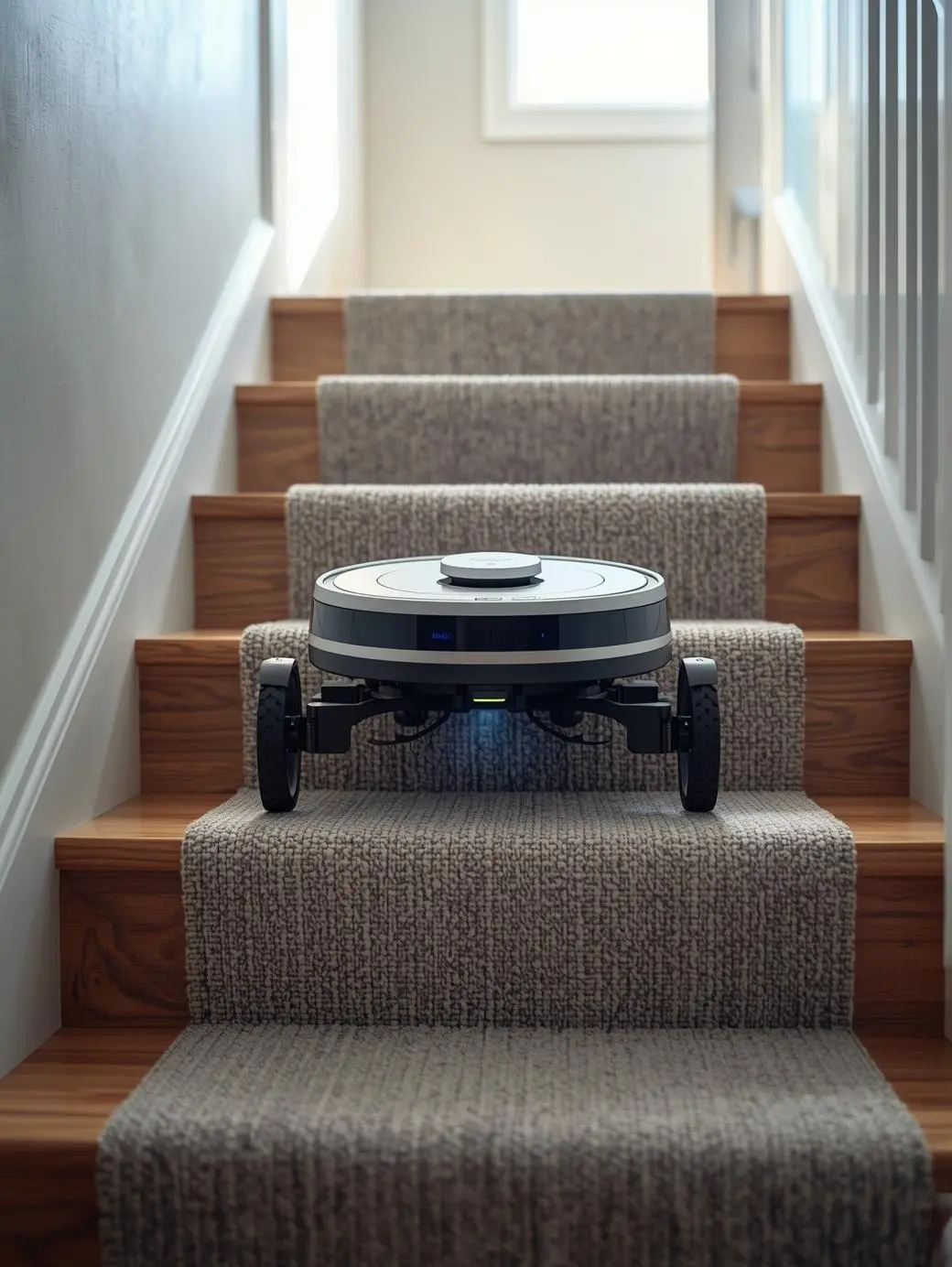
The decade-long wait for a stair climbing robot vacuum is finally over. At CES 2026, Roborock unveiled the Saros Rover, the world’s first robotic vacuum featuring AI-powered wheel-leg architecture that can navigate, climb, and clean entire staircases autonomously while maintaining human-like agility. This isn’t a mobility gimmick—the Rover actually vacuums each step as it ascends, cleaning stairs that have remained off-limits to robot vacuums since the category’s inception.
For homeowners with multi-level homes, this matters because the stair climbing robot vacuum breakthrough eliminates the single biggest limitation of robotic floor cleaning—forcing users to carry heavy vacuums between floors or maintain multiple units. Roborock became the most awarded robotic vacuum brand at CES 2026 after demonstrating the Rover successfully navigating curved staircases, dodging fast-moving obstacles like pets, and even performing small jumps to overcome thresholds. Industry experts confirm this innovation represents “the future of robot vacuums,” fundamentally changing multi-level home cleaning forever.
Table of Contents
The Roborock Saros Rover: World’s First Wheel-Leg Architecture
Revolutionary Two-Wheel-Leg Design
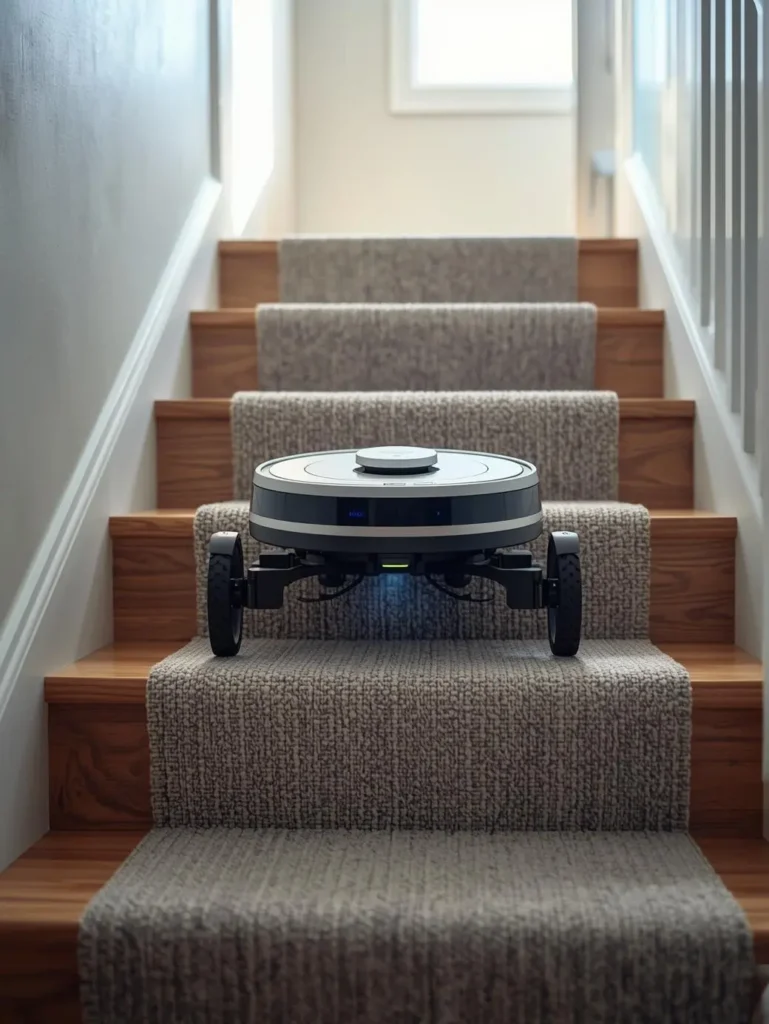
The stair climbing robot vacuum features the world’s first two-wheel-leg architecture in a robovac, with each wheel-leg providing reach, lift, height control, and human-like mobility. The system enables the robot to raise and lower each wheel-leg independently, execute small jumps, perform agile turns, make sudden stops, and change direction—all while maintaining a level body as the ground changes beneath it.
Unlike traditional robot vacuums limited to flat surfaces, or Dreame’s Cyber X concept using rubber tracks for mobility only, the Roborock stair climbing robot vacuum actively cleans stairs during ascent. The wheel-leg system allows it to pause, adjust positioning, and scrub each stair individually before advancing to the next step—a level of precision impossible with track-based designs.
Live demonstrations at CES 2026 showed the Rover intelligently detecting stairs, cleaning each step methodically, and climbing to the next level of a home. The robot also descended slopes with smooth control, utilizing its motor to brake, stop, turn, and reverse up inclines.
AI Navigation and 3D Spatial Awareness
The stair climbing robot vacuum uses advanced AI algorithms paired with motion sensors and 3D spatial information to understand its environment and react with precision. This combination enables the wheel-legs to respond autonomously to curved and carpeted staircases while maintaining stability and cleaning effectiveness.
The AI-driven navigation system lets the Rover adapt to different surfaces, tackle multi-level thresholds, and navigate small ramps without human intervention. During CES demos, it successfully avoided fast-moving objects like pets and children, demonstrating real-time obstacle detection and avoidance capabilities that exceed current robot vacuum standards.
Roborock representatives confirmed the system can ascend and descend stairs using the same wheel-leg technique, and can travel between floors without engaging the vacuum function when users want faster navigation to upstairs rooms. This flexibility positions the stair climbing robot vacuum as a true whole-home cleaning solution rather than a floor-specific tool.
Current Limitations and Development Status
Roborock explicitly states the Saros Rover is “a real product in development” rather than a distant concept, but has not announced pricing or a release date. The company confirmed the Rover currently functions solely as a vacuum without mopping capability, stating they’re “still determining which of our mop systems will be compatible or if we will pursue a completely different approach”.
Early demonstrations revealed some bugs that need resolution before commercial release. However, the fully operational prototype performing complex stair navigation at CES indicates genuine technical maturity rather than vaporware. Given that Roborock’s previous flagship model, the Saros Z70 with a robotic arm, launched at $2,600, industry analysts expect the stair climbing robot vacuum to command premium pricing when it eventually reaches market.
CES 2026: Competing Stair-Climbing Innovations
Dreame Cyber X: Track-Based Mobility Approach
Dreame showcased its Cyber X concept at CES 2026, featuring retractable rubber tracks that allow autonomous navigation of stairs and multi-level terrain. The device can tackle steps up to 25cm (9.8 inches) high and inclines of 42 degrees, climbing a full flight in approximately 27 seconds. A built-in braking system ensures the device locks in place even if the battery dies mid-climb.
The critical difference between Dreame’s approach and the stair climbing robot vacuum from Roborock lies in cleaning capability. The Cyber X uses its tracked chassis to transport itself between floors for cleaning but doesn’t vacuum stairs during ascent—it’s a mobility solution rather than a stair-cleaning innovation. The Roborock Saros Rover, by contrast, cleans each step as it climbs, addressing the complete stair cleaning challenge.
Dreame’s Cyber X prioritizes efficiency and speed with its tracked design, enabling quick multi-floor transitions and coverage of large areas in single passes. This makes it ideal for homeowners who want a single robot vacuum covering multiple floors but don’t specifically need stair cleaning.
The IFA 2025 Stair Lift Trend
At IFA 2025, numerous companies showcased stair lifts for robot vacuums—external mechanisms that transport traditional disc-shaped vacuums between floors. These solutions addressed mobility limitations but required separate hardware installations and didn’t enable stair cleaning. The emergence of integrated stair climbing robot vacuum designs at CES 2026 represents the natural evolution from external lifts to self-propelled climbing systems.
This progression signals the maturation of robot vacuum technology from basic dirt collection to sophisticated machines capable of whole-home navigation, clutter management, and now vertical mobility with active cleaning.
Roborock’s CES 2026 Product Lineup
Saros 20 and Saros 20 Sonic Flagships
Alongside the revolutionary Rover, Roborock announced the Saros 20 and Saros 20 Sonic as its latest flagship offerings in the Saros Series. Both models feature enhanced AI object recognition, an upgraded AdaptiLift Chassis 3.0 for improved threshold climbing, and 35,000 Pa HyperForce suction. The AdaptiLift system enables navigation over multi-layer thresholds up to 0.77 inches tall and single-layer thresholds up to 0.57 inches tall.
A new climbing arm allows the robots to lift and lower themselves smoothly without jarring sounds, beneficial for navigating sunken living rooms, shallow sunroom steps, or transitions between flooring types. The dynamic carpet cleaning mode lets vacuums elevate at multiple levels according to carpet thickness, maintaining optimal airflow.
Both flagship models include built-in livestream video cameras and pet monitoring features. Pricing hasn’t been officially announced, but industry analysts estimate the Saros 20 at approximately $1,599.99 and the Saros 20 Sonic between $1,699.99-$1,799.99 based on previous year’s launch pricing.
Qrevo Curv 2 Flow: Affordable Innovation
The Qrevo Curv 2 Flow launches January 19, 2026, with an introductory price of $849 (rising to $999 after February 1). This model represents Roborock’s first robot cleaner equipped with a self-refreshing spinning roller mop—a style that has quickly become popular among consumers. The Qrevo Curv 2 Flow demonstrates that while the stair climbing robot vacuum garners headlines, Roborock continues innovating across all price points.
Expert Analysis: Is Stair-Climbing Worth the Wait and Cost?
The Multi-Level Home Game-Changer
The stair climbing robot vacuum solves the fundamental limitation that has prevented robot vacuums from achieving true “whole-home” automation in multi-story residences. For a decade, homeowners with stairs faced three unsatisfying options: manually carry the robot between floors, purchase multiple units (one per level), or accept that stairs would never get vacuumed by robots.
The Saros Rover eliminates these compromises by cleaning stairs while ascending to upper floors, significantly minimizing “no-go zones” and accessing areas previously unreachable with a single robovac. This represents genuine innovation rather than incremental improvement—it fundamentally changes what robot vacuums can accomplish.
For comprehensive comparisons of robot vacuum capabilities across all price ranges, including stair-climbing technologies and traditional models, visit our [Product Reviews page] where we test real-world performance, navigation accuracy, and cleaning effectiveness.
Cleaning Performance vs. Mobility Trade-Offs
The stair climbing robot vacuum’s wheel-leg system enables meticulous, stair-by-stair cleaning with precise positioning adjustments on each step. However, this thoroughness comes at the cost of speed—methodical step cleaning takes significantly longer than Dreame’s Cyber X can traverse stairs purely for mobility. Homeowners prioritizing comprehensive stair cleaning should favor the Saros Rover, while those needing quick multi-floor coverage without stair cleaning might prefer track-based alternatives.
The current vacuum-only limitation means the Rover cannot mop stairs—a capability Roborock acknowledges needs development. Since hard-surface stairs often require mopping more than vacuuming, this limitation impacts the product’s immediate utility for homes with tile, hardwood, or laminate staircases. However, carpeted stairs—where vacuuming is paramount—benefit fully from the technology in its current form.
Pricing Reality and Market Positioning
Without official pricing, industry analysis provides educated estimates based on Roborock’s product hierarchy. The Saros Z70, featuring a robotic arm but no stair-climbing capability, launched at $2,600. The stair climbing robot vacuum incorporating more complex wheel-leg architecture, advanced AI, and specialized motors will likely command equal or higher pricing—potentially $2,500-$3,000 at launch.
This premium positioning limits initial adoption to early adopters and affluent households willing to invest in cutting-edge home robotics. However, the technology’s novelty and practical utility for multi-level homes may justify premium pricing for homeowners who have long waited for this exact capability. As production scales and competitors enter the market, second-generation models will likely reach more accessible price points by 2027-2028.
The Robotic Arm Integration Future
Roborock has not equipped the Rover with a robotic arm, but industry observers believe it’s “merely a matter of time” before this combination appears. The Saros Z70 already features an extendable arm for obstacle manipulation, and integrating that capability with stair-climbing mobility would create the most comprehensive home cleaning robot ever conceived. This progression signals rapid evolution in robot vacuum capabilities—from basic dirt collection to machines that clean multiple surfaces, manage clutter, climb stairs, and potentially handle dishes or laundry.
Key Takeaways: What You Need to Know
- Roborock’s stair climbing robot vacuum Saros Rover features world-first wheel-leg architecture enabling it to climb and clean stairs simultaneously, not just traverse them for mobility
- AI algorithms combined with motion sensors and 3D spatial awareness allow independent wheel-leg control for jumps, turns, sudden stops, and slope navigation while maintaining level body positioning
- The Rover is a “real product in development” with fully operational CES 2026 demos, but Roborock hasn’t announced pricing or release dates—expect $2,500-$3,000 based on comparable flagship models
- Dreame’s competing Cyber X uses rubber tracks to climb stairs in 27 seconds but doesn’t clean during ascent, positioning it as a mobility solution rather than comprehensive stair-cleaning technology
- Current limitations include vacuum-only functionality (no mopping), early software bugs requiring refinement, and premium pricing that will initially limit adoption to early adopters
- CES 2026 recognition as Best Smart Home Tech and status as most awarded robotic vacuum brand validates Roborock’s innovation leadership in the category
Climbing Toward the Future
The stair climbing robot vacuum represents more than incremental innovation—it fundamentally redefines what robot vacuums can accomplish in multi-level homes. Roborock’s Saros Rover solves the decade-old question of “when will it tackle my stairs?” with technology that doesn’t just climb stairs but actively cleans them step-by-step during ascent.
The journey from rudimentary disc units that merely collected dirt to advanced machines capable of climbing stairs, avoiding obstacles in real-time, and maintaining precise cleaning patterns demonstrates extraordinary technological progress. While pricing remains unannounced and mopping capability requires future development, the fully operational CES 2026 prototype proves this isn’t vaporware—it’s genuine engineering ready for commercial refinement.
Early adopters willing to invest in first-generation stair climbing robot vacuum technology will gain immediate benefits in multi-level home cleaning automation, accepting potential bugs and premium pricing as the cost of frontier technology. Mainstream consumers can wait 1-2 years for second-generation models with resolved issues, added mopping capability, and lower pricing as manufacturing scales and competition increases.
The robot vacuum revolution continues accelerating, with stair-climbing capability representing the latest breakthrough in the category’s evolution toward fully autonomous whole-home cleaning. What once seemed like science fiction—a robot vacuum independently cleaning every surface in your home, from basement to attic—moves closer to reality with each CES innovation showcase.
Would you invest in a $2,500-$3,000 stair climbing robot vacuum when it launches? Do you need full stair cleaning capability or just multi-floor mobility? Share your thoughts on this breakthrough technology in the comments below.
Ready to upgrade every corner of your home? From cozy seating like this Furlide chair to high-tech kitchen gadgets, we’ve got you covered. Check out our Full Library of Home Product Reviews to discover more expert-tested gear for your lifestyle.
[…] Roborock Saros Rover: Stair-Climbing Robot Vacuum 2026 […]