



The Overmont 5.5-Quart Enameled Cast Iron Dutch Oven is a premium yet affordable cookware essential designed for home cooks, baking enthusiasts, slow-cooking aficionados, and families seeking restaurant-quality results at home. This beautifully crafted pot features high-grade cast iron construction with a three-layer chip-resistant enamel coating available in eight elegant colors including cream white, red, navy, and more. The innovative self-basting lid design features interior condensation dots that redistribute moisture evenly throughout cooking, keeping roasts juicy and stews flavorful without constant monitoring. Perfect for artisan bread bakers, the 5.5-quart capacity provides optimal space for no-knead sourdough recipes while the tight-fitting lid traps steam to create bakery-quality crusts. This versatile pot works seamlessly on all cooktops including induction, gas, electric, and ceramic, plus it's oven-safe up to 500°F for searing on the stovetop and finishing in the oven. The complete package includes two cotton handle covers, an insulation pad/trivet, and a 10-recipe cookbook, making it an exceptional value for beginners and experienced cooks alike.
Enameled cast iron dutch oven creates professional steam environment for crusty bread, retains heat 9% better, lasts generations without PFAS toxins.
Table of Contents
It’s Sunday morning. You attempt homemade bread in a regular pan. The loaf comes out pale, dense, and disappointingly flat—nothing like the golden-crusted, airy masterpieces you see at artisan bakeries. Your family politely eats one slice. The rest goes stale.
The missing ingredient isn’t skill or expensive flour. It’s steam. Professional bread ovens inject steam that keeps crusts soft during oven spring, allowing maximum expansion before the final crisp. Home ovens can’t replicate this without specialized equipment—until you use an enameled cast iron dutch oven.
The Overmont enameled cast iron dutch oven creates a self-steaming environment where the dough’s moisture becomes trapped, delivering bakery-quality crusty bread with airy crumb structure. The 5.5-quart capacity handles everything from no-knead loaves to braised meats, while retaining heat 9% better than stock pots for superior slow-cooking results. Unlike bare cast iron requiring constant seasoning, the enamel coating is ready to use immediately, handles acidic foods without metallic taste, and contains zero PFAS forever chemicals.
Steam Creates Bakery-Quality Crusty Bread at Home
Professional bread requires steam during the first 15-20 minutes of baking. This steam keeps the crust supple and moist, allowing the dough to expand fully before the crust sets. Without steam, breads end up “squat, with a dull, tough crust” lacking the glossy shine and dramatic oven spring of professional loaves.
The science is precise: steam “hydrates the starches on the outer layers of the developing crust” causing them to form a gel at 140°F. This glossy, reflective gel allows continued expansion. When steam is removed mid-bake, the gelled starches “heat up further, causing them to expand rapidly and dry out, leaving them airy and crisp”.
Home bakers attempting professional results face impossible challenges. You can’t inject steam like commercial ovens. Placing water pans in the oven creates minimal, uncontrolled steam that dissipates quickly. Regular pans lack the sealing capability to trap moisture.
An enameled cast iron dutch oven solves this completely. “The lid to the Dutch oven traps the steam from the sticky dough inside, making it a perfect bread baking environment”. You bake the loaf covered for the first 20-30 minutes, allowing the dough’s own moisture to create intense steam. Then you remove the lid for the final 10-15 minutes, allowing “that steam to escape” so the crust browns and crisps dramatically.
Professional bakers confirm: “The trapped steam keeps the crust soft (delays crust formation), which allows for maximum expansion and the largest, most open crumb possible”. This enameled cast iron dutch oven method “produces a loaf with the best volume, most open interior structure, and crispiest crust, with deep, burnished color”.
Users report never needing to add water when baking in an enameled cast iron dutch oven. “The steam from the dough is sufficient to create a nice crust” without any additional intervention. The tight-fitting lid creates a self-contained steam chamber that rivals professional equipment.
Cast Iron Retains Heat 9% Better Than Stock Pots
Heat retention determines cooking quality for slow-cooked dishes. When you open the oven to baste meat or add ingredients, significant heat escapes. Thin aluminum stock pots “lose heat quickly” requiring frequent temperature recovery that creates uneven cooking.
Professional testing found enameled cast iron dutch ovens “outperform stock pots by about 9%” in heat retention. This superior performance stems from cast iron’s “high thermal mass”—the material’s exceptional ability to absorb and store heat.
The physics are straightforward: cast iron is “dense and heavy” with “higher capacity to absorb heat energy compared to lightweight metals like aluminum or stainless steel”. Once heated, cast iron “takes longer to cool down, maintaining a stable and consistent cooking temperature even after the heat source is turned off”.
This thermal mass creates transformative cooking advantages. When you add cold ingredients to a thin pot, temperature plummets, requiring time to recover. An enameled cast iron dutch oven “maintains its temperature despite external influences”. This proves “perfect for tasks like searing steaks or frying, where maintaining high temperatures is crucial to achieving a perfect crust and deep, even browning”.
The consistent heat “ensures that food is cooked thoroughly and evenly without sudden drops in temperature”. For long-cooked braises and stews requiring 2-4 hours, this stability prevents hot spots, scorching, and the constant temperature monitoring thin pots demand.
Professional chefs emphasize that cast iron’s “ability to stay hot for extended periods makes it an excellent choice for keeping food warm at the table, reducing the need for reheating”. Your enameled cast iron dutch oven serves as both cooking vessel and serving dish, maintaining food temperature throughout dinner.
Superior Heat Distribution Eliminates Hot Spots
Uneven cooking ruins expensive ingredients. You’re braising short ribs and the bottom burns while the top remains undercooked. Thin pots create hot spots where food in contact with the heat source cooks faster than food just inches away.
Cast iron’s “thick walls evenly spread heat across the pot, ensuring food cooks uniformly without hot spots”. This even distribution stems from the material’s thermal conductivity combined with substantial thickness.
Professional testing confirms: “The high thermal mass ensures that heat is distributed evenly across the entire surface of the pot, eliminating the risk of burning or undercooking parts of your dish”. The enameled cast iron dutch oven creates “consistent temperature” throughout the cooking chamber.
This quality proves “essential when making dishes that require long, slow cooking times, such as braises, stews, and casseroles, as it prevents burning or uneven cooking”. Food develops complex flavors uniformly rather than producing burnt sections mixed with undercooked areas.
The thick construction also enables versatile heat sources. An enameled cast iron dutch oven performs “exceptionally well” on “gas stoves, electric burners, induction cooktops, open flames, or even in ovens”. The heat distribution remains consistent regardless of whether heat comes from below (stovetop) or surrounds the pot (oven).

Enamel Coating Eliminates Seasoning Requirements
Bare cast iron demands constant maintenance. You’re carefully seasoning, avoiding soap, hand-drying immediately, and storing with oil to prevent rust. Skip any step and the seasoning degrades, causing food to stick and rust to develop.
The enamel coating on this enameled cast iron dutch oven “simplifies maintenance, as it doesn’t require seasoning like bare cast iron”. The glass-like enamel surface is “immediately ready to use” without any preparation. You unbox it, wash it, and start cooking.
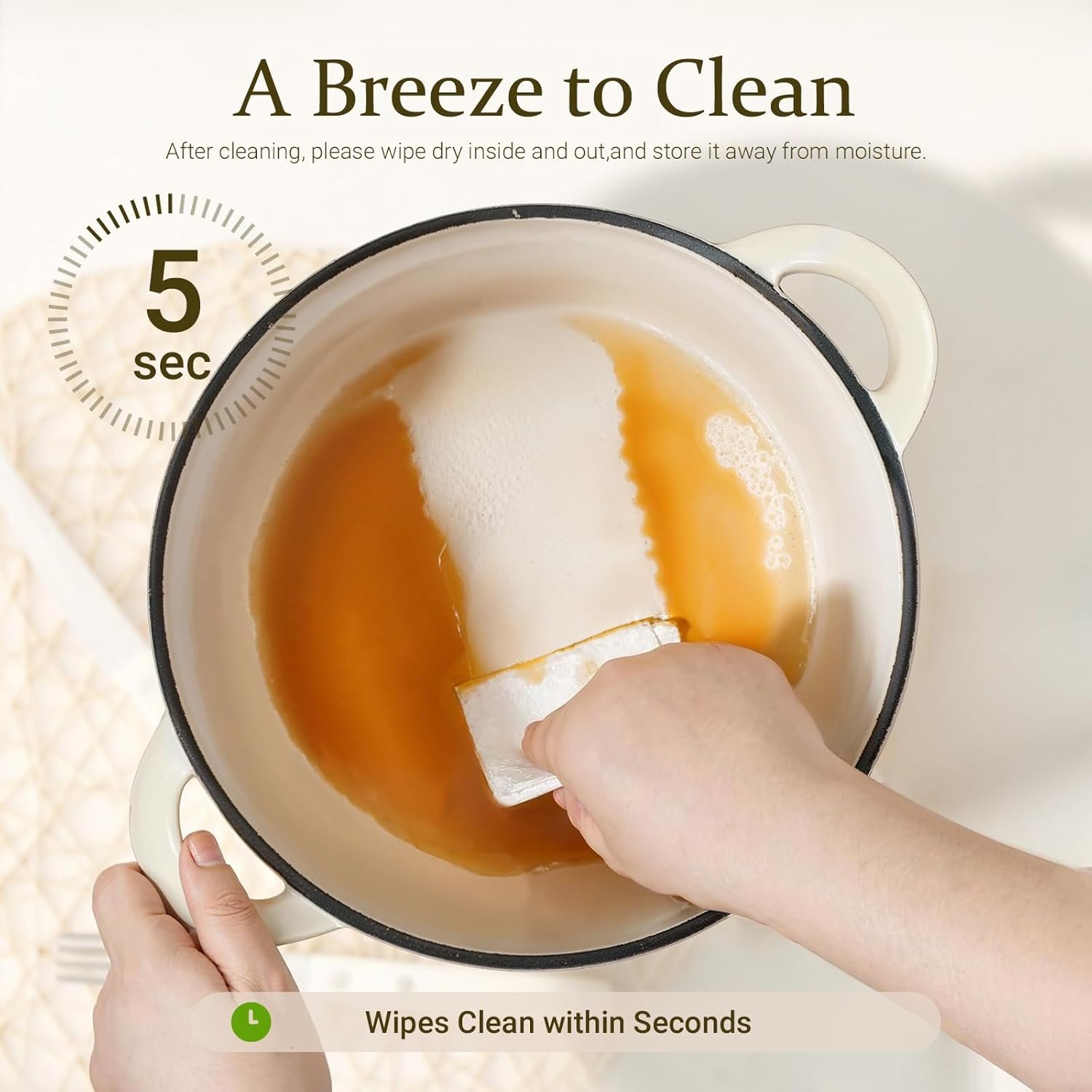
Cleaning becomes effortless. “It can be cleaned with soap without any concern”. The enamel’s non-reactive surface tolerates dish soap that would strip bare cast iron seasoning. After cooking, wash the enameled cast iron dutch oven like any other pot—no special techniques required.
Long-term reviews confirm durability. One user reported after 4+ years: “The enamel is not peeling off or going into my food. Overall the coating, the enamel has been flawless. The non-stick properties that you would expect from enameled is all still there. There has been zero issues”. Premium enamel “survives decades of metal spoons” according to professional assessments.
The enamel also prevents bare iron exposure. While bare cast iron can rust if moisture contacts the surface, the enamel creates an impermeable barrier. Your enameled cast iron dutch oven tolerates wet storage without rust concerns.
Users appreciate the “simple cleaning” advantage: “They can be cleaned with soap” and don’t demand the careful maintenance bare cast iron requires. The enameled cast iron dutch oven combines cast iron’s thermal benefits with modern convenience.
Non-Reactive Surface Handles Acidic Foods Safely
Cooking acidic foods in bare cast iron creates problems. Tomatoes, wine-based sauces, citrus, and vinegar-heavy dishes react with the iron, stripping away seasoning and imparting metallic tastes to your food.
The enamel coating provides a “non-reactive surface” that’s “perfect for recipes that involve tomatoes or citrus”. Professional assessments confirm enameled cast iron dutch ovens are “superior in slow cooking and acidic foods such as tomato-based sauces”.
The chemistry is simple: “The enamel barrier ensures that no reactions occur, keeping your sauces tasting pure and your cookware in top condition”. You can simmer marinara sauce for hours, braise meat in red wine, or cook citrus-based dishes without worrying about metal leaching or off-flavors.
This versatility expands your recipe options dramatically. Classic dishes like beef bourguignon (wine-based), osso buco (tomato-rich), and Hungarian goulash (tomato and vinegar) all rely on acidic ingredients that bare cast iron can’t handle properly. The enameled cast iron dutch oven excels at these applications.
Professional chefs emphasize that enameled vessels can be used to “cook acidic foods such as wine-based stews or tomato sauces” without compromising taste or cookware integrity. Your enameled cast iron dutch oven handles the complete range of global cuisines.
Stovetop-to-Oven Versatility Creates One-Pot Meals
Traditional cooking requires multiple vessels. You sear meat in a skillet, transfer it to a roasting pan for the oven, then move it again to a serving dish. Each transfer loses heat, creates cleanup, and risks spills.
An enameled cast iron dutch oven “can go from stovetop to oven, which means you can sear meat, sauté vegetables, and then finish everything in the oven—all in a single pot”. This seamless transition transforms cooking logistics.
The technique delivers superior results. Start by searing meat on the stovetop at high heat, developing deep caramelization. Add aromatics and sauté until fragrant. Pour in braising liquid. Cover with the tight-fitting lid and transfer the entire enameled cast iron dutch oven to a 325°F oven for 2-4 hours.
This method “not only saves time but also minimizes cleanup, as you’ll only have one pot to wash”. Professional cooks appreciate that “this method of cooking allows flavors to meld together, creating dishes with more depth and complexity”.
One-pot cooking delivers measurable efficiency gains. Time use data shows one-pot meals reduce “daily food preparation by 70–80%” compared to traditional multi-vessel cooking. Cleanup time drops from 15-20 minutes to just 3-5 minutes—a 75-83% reduction.
The enameled cast iron dutch oven’s temperature tolerance enables this versatility. It withstands “high-temperature ovens” up to 500°F while also performing excellently on stovetops. Stock pots, by contrast, are “more limited to stovetop cooking or gentle oven use” and may warp with temperature cycles.
5.5-Quart Capacity Feeds Families Without Batch Cooking
Small pots force batch cooking. You’re making beef stew for six people in a 3-quart pot, browning meat in three batches while the first batch cools. The extended prep time defeats the purpose of one-pot cooking.
This 5.5-quart enameled cast iron dutch oven provides “ideal” capacity for family meals. The volume accommodates 4-6 servings of stews, braises, and soups without crowding. A whole chicken fits comfortably for roasting.
Professional testing confirms 5-7 quart dutch ovens represent the “sweet spot” for most households. Smaller models (3-4 quarts) limit recipe options while larger models (8+ quarts) become unwieldy and difficult to handle when full.
The capacity also supports batch cooking for meal prep. Make a double recipe of chili or soup on Sunday, eating some immediately and freezing the rest in portions. Research shows batch cooking delivers 34% cost savings compared to daily takeout while reducing food waste by 50-67%.
Users specifically appreciate how larger dutch ovens “minimize cooking time and cleanup” by enabling complete meals in one vessel. The 5.5-quart enameled cast iron dutch oven balances generous capacity with reasonable weight and storage footprint.
Tight-Fitting Lid Traps Moisture for Tender Results
Cooking without proper sealing causes moisture loss. You’re braising short ribs and every oven check releases steam, drying the meat despite being submerged in liquid. Regular pot lids don’t seal tightly, allowing evaporation that concentrates flavors excessively while toughening proteins.
The heavy lid on an enameled cast iron dutch oven “helps trap steam, keeping food moist while allowing the flavors to meld together”. The weight creates effective sealing even without gaskets or clamps.
This moisture retention proves critical for specific techniques. Braising relies on humid environments where tough cuts transform into fork-tender deliciousness over 2-4 hours. The enameled cast iron dutch oven’s sealed cooking chamber maintains optimal humidity throughout.
Professional chefs emphasize that dutch ovens “create the perfect environment for building rich flavors, particularly for dishes like stews, roasts, and braises”. The sealed chamber allows flavors to concentrate without liquid evaporating away.
The tight seal also enables gentle simmering. Rather than aggressive boiling that toughens meat, the enameled cast iron dutch oven maintains low-temperature simmers that break down collagen without overheating. The result: “deliciously tender meats and intensely flavorful sauces that are hard to achieve in other types of cookware”.

Completely PFAS-Free Non-Toxic Cookware
PFAS “forever chemicals” contaminate many non-stick cookware products, accumulating in human bodies and causing health concerns. These synthetic compounds persist indefinitely in the environment and human tissue.
Cast iron—both bare and enameled—contains zero PFAS. “Lodge has been made without PFAS since the beginning” according to manufacturer verification. Third-party laboratory testing confirms cast iron cookware is “free not only of PFAS, but also dangerous levels of Lead and Cadmium”.
The enameled cast iron dutch oven represents one of the “safest materials to cook with” according to health experts with nearly two decades researching toxic exposures. It’s “naturally PFAS-free, durable, and versatile” without relying on “synthetic coatings for performance”.
Safety guides consistently rank enameled cast iron among top non-toxic cookware choices. The material “does not rely on synthetic coatings for performance, which means there’s relatively low risk of chemical off-gassing or microplastic shedding into your food”.
The enamel itself requires verification. Quality manufacturers ensure enamel is “certified lead-free” meeting safety standards for food contact. This enameled cast iron dutch oven provides the “benefits of cast iron with an easy-to-clean glass-like coating” without toxic additives.
Health-conscious cooks appreciate that cast iron is “proudly made without PFAS” and “never needs to see a landfill”. Your enameled cast iron dutch oven represents heirloom-quality cookware free from modern chemical concerns.
Lasts Generations With Proper Care
Cookware replacement costs accumulate. You’re buying new non-stick pans every 1-3 years as coatings degrade. Over a lifetime, that’s dozens of pans in landfills and thousands in replacement costs.
Premium enameled cast iron dutch ovens “last for decades, even generations” according to professional assessments. Users report the same pot lasting “65+ years” with proper maintenance. One reviewer noted their Le Creuset “can last indefinitely” when cared for appropriately.
The longevity stems from fundamental material properties. Cast iron doesn’t degrade—it’s solid metal throughout. The enamel coating, when quality-applied in “multiple protective layers,” resists chipping and maintains integrity for decades.
Professional reviews confirm: “Premium enameled cast iron consistently survives impact tests that would damage cheaper options”. The durability “justifies their higher price for serious cooks” because the per-year cost becomes negligible.
The investment calculation proves compelling. A $200 enameled cast iron dutch oven used for 50 years costs $4 annually. Replacing $30 stock pots every 5 years costs $6 annually while providing inferior cooking performance. The quality dutch oven pays for itself through longevity alone.
Maintenance requirements remain minimal. “Quick soap-and-water cleans” for daily use, “overnight bleach soaks that erase stubborn stains” for deep cleaning, and “paper-towel spacers that prevent rust and chips” for storage. Follow these simple practices and your enameled cast iron dutch oven becomes a family heirloom passed to children.
Versatile Functions Replace Multiple Appliances
Specialized appliances clutter kitchens. You own a soup pot, roasting pan, bread cloche, slow cooker, and fry pot—each consuming storage space while serving single purposes.
An enameled cast iron dutch oven “excels at slow-cooking, sautéing, roasting, braising, and even baking, making them incredibly versatile”. Professional chefs confirm these vessels handle “braise meats, bake bread, roast vegetables, fry chicken, simmer soups, and even make desserts”.
The breadth proves remarkable. For breakfast, use the enameled cast iron dutch oven for baked oatmeal or frittatas. Lunch brings soups and stews. Dinner options include pot roast, braised short ribs, whole roasted chicken, or vegetable casseroles. Dessert possibilities include cobblers, upside-down cakes, and bread pudding.
The deep-frying capability surprises many users. The enameled cast iron dutch oven’s “thick walls and excellent heat retention properties ensure consistent oil temperature, crucial for achieving perfectly fried foods”. From “crispy chicken wings to homemade donuts,” the frying performance rivals dedicated fryers.
Global cuisines demonstrate the versatility. French beef bourguignon, Hungarian goulash, Italian osso buco, American pot roast, Mexican pozole, Thai curries, Indian biryanis, and countless other dishes all optimize when cooked in an enameled cast iron dutch oven.
Professional assessments emphasize this “adaptability makes it a go-to piece for both amateur and professional cooks who appreciate the flexibility of having a single pot that can handle various cooking methods”. Your enameled cast iron dutch oven consolidates multiple appliances into one supremely capable vessel.
Included Cookbook Provides Recipe Inspiration
New cookware creates paralysis. You own a beautiful dutch oven but don’t know what to make beyond basic stew. Without guidance, the pot sits unused despite its potential.
This package includes a cookbook specifically designed for enameled cast iron dutch oven cooking. The recipes leverage the pot’s unique capabilities—steam-trapped bread baking, moisture-sealed braising, and even heat distribution for perfect results.
Professional bread recipes prove particularly valuable. Dutch oven bread baking requires specific techniques: proper dough hydration, covered baking duration, and lid-removal timing. The included recipes provide tested parameters eliminating guesswork.
Stew and braise recipes showcase how the enameled cast iron dutch oven’s heat retention and tight seal transform tough cuts into tender masterpieces. The cookbook guides you through building flavors through proper searing, liquid selection, and timing.
Having curated recipes increases appliance usage significantly. Research shows users with recipe resources cook at home more frequently, reducing takeout spending by 34% while improving nutrition. The cookbook transforms your enameled cast iron dutch oven from intimidating investment to daily cooking companion.
Cotton Potholders Protect Hands From Hot Handles
Cast iron retains heat so effectively that handles stay burning-hot long after cooking completes. You finish braising, turn off the heat, and 20 minutes later the handles still cause burns.
The included cotton potholders provide essential protection. Unlike thin kitchen towels that fold unevenly or slip, proper potholders offer insulated gripping surfaces designed for heavy cookware.
The necessity stems from the enameled cast iron dutch oven’s weight when full. A 5.5-quart pot filled with stew weighs 15-20 pounds. You need secure, protected grip to safely transfer the vessel from stovetop to oven or lift it for serving.
Quality potholders also prevent countertop damage. The cast iron bottom retains intense heat that can scorch wooden counters or damage laminate. Potholders double as trivets, providing insulated surfaces for safe placement.
Users appreciate when manufacturers include accessories that acknowledge real-world use cases. The potholders signal that the company understands enameled cast iron dutch oven ownership requires specific tools beyond the pot itself.
Perfect for Your Kitchen If You…
This enameled cast iron dutch oven solves specific cooking challenges. It’s ideal if you:
- Want to bake bakery-quality crusty bread with airy crumb at home
- Need heat retention 9% better than stock pots for superior slow-cooking
- Prefer cookware eliminating constant seasoning requirements
- Cook acidic foods like tomato sauces without metallic taste concerns
- Want stovetop-to-oven versatility for seamless one-pot meals
- Need 5.5-quart capacity feeding 4-6 people without batch cooking
- Seek tight-fitting lids that trap moisture for tender braised meats
- Prioritize completely PFAS-free non-toxic cookware
- Want cookware lasting generations rather than requiring replacement
- Need versatile functions replacing multiple specialized appliances
- Appreciate included cookbook providing recipe inspiration
- Want cotton potholders protecting hands from hot cast iron handles
- Seek heirloom-quality pieces becoming family treasures
- Cook for families reducing takeout through home meal preparation
- Value even heat distribution eliminating hot spots and burning

Your Questions Answered About Enameled Cast Iron Dutch Oven
Why does bread baked in a dutch oven turn out better?
The tight-fitting lid traps steam from the dough, creating a humid environment that keeps the crust soft during oven spring. This allows maximum expansion before the crust sets. Removing the lid for the final 10-15 minutes allows steam to escape so the crust browns and crisps. This enameled cast iron dutch oven method “produces a loaf with the best volume, most open interior structure, and crispiest crust”.
Do I really need to season an enameled dutch oven?
No. The enamel coating is “immediately ready to use” without any seasoning. Unlike bare cast iron requiring careful oil treatments, enameled cast iron dutch ovens are washed and ready for cooking straight from the box. The enamel creates a non-reactive surface that “can be cleaned with soap without any concern”.
Can I use metal utensils in enameled cast iron?
It’s “better to be avoided” because metal utensils “may chip or scratch the enamel”. Use wooden, silicone, or plastic utensils to preserve the coating. While premium enamel “survives decades of metal spoons,” consistent metal utensil use increases chipping risk. This enameled cast iron dutch oven provides long-term durability when treated appropriately.
How is this better than a regular stock pot?
Enameled cast iron dutch ovens “outperform stock pots by about 9%” in heat retention. They provide “even heat distribution” eliminating hot spots. The thick walls enable “stovetop-to-oven” versatility while stock pots are “limited to stovetop cooking or gentle oven use”. This enameled cast iron dutch oven maintains consistent temperature and withstands high-heat applications stock pots cannot.
Will the enamel chip or peel off?
Quality enamel with “multiple protective layers” resists chipping with proper care. Users report after 4+ years: “The enamel is not peeling off” and “there has been zero issues”. Avoid thermal shock (don’t put cold water in a hot pot), use non-metal utensils, and hand-wash rather than dishwasher for maximum longevity. Premium enameled cast iron dutch ovens last “65+ years” with appropriate maintenance.
Is 5.5 quarts big enough for a family?
Yes. This capacity handles “4-6 servings” of stews, soups, and braises. A whole chicken fits comfortably. Professional testing identifies 5-7 quarts as the “sweet spot” for most households—large enough for family meals without becoming unwieldy. The 5.5-quart enameled cast iron dutch oven balances generous capacity with manageable weight.
Does it really contain no PFAS or toxic chemicals?
Cast iron—both bare and enameled—contains zero PFAS. Third-party testing confirms cast iron is “free not only of PFAS, but also dangerous levels of Lead and Cadmium”. Quality enameled cast iron dutch ovens use “certified lead-free” enamel meeting food safety standards. This represents one of the “safest materials to cook with” according to health experts.
Can I cook tomato sauce without damaging the pot?
Yes. The enamel coating creates a “non-reactive surface” specifically designed for acidic foods. Enameled cast iron dutch ovens are “superior in slow cooking and acidic foods such as tomato-based sauces”. The “enamel barrier ensures that no reactions occur, keeping your sauces tasting pure” without stripping seasoning or imparting metallic flavors.
Stop Making Dense Bread and Tough Meat With Wrong Cookware
Every time you bake bread in a regular pan, it comes out “squat, with a dull, tough crust” lacking the glossy shine and dramatic oven spring of professional loaves. The missing ingredient is steam—that humid environment keeping crusts soft during expansion. Home ovens can’t inject steam like commercial equipment, leaving your bread disappointingly flat.
Meanwhile, your thin stock pot loses heat rapidly when you open it to check braising meat. Temperature drops require recovery time creating uneven cooking that toughens proteins rather than tenderizing them. Hot spots burn the bottom while the top remains undercooked.
You deserve professional results at home. This enameled cast iron dutch oven provides them.
“The lid traps steam from the sticky dough inside, making it a perfect bread baking environment” that produces “the best volume, most open interior structure, and crispiest crust”. Users confirm “the steam from the dough is sufficient to create a nice crust” without any additional intervention.
Heat retention “outperforms stock pots by about 9%” while “thick walls evenly spread heat across the pot, ensuring food cooks uniformly without hot spots”. The “high thermal mass” maintains “stable and consistent cooking temperature even after the heat source is turned off”.
The enamel coating “simplifies maintenance” because it’s “immediately ready to use” without seasoning. “It can be cleaned with soap without any concern”. After 4+ years, users report “the enamel has been flawless” with “zero issues”.
“Stovetop-to-oven versatility” means “you can sear meat, sauté vegetables, and then finish everything in the oven—all in a single pot”. This “not only saves time but also minimizes cleanup” while creating “dishes with more depth and complexity”.
The 5.5-quart capacity handles “4-6 servings” for complete family meals. The non-reactive enamel is “perfect for recipes that involve tomatoes or citrus”. Completely PFAS-free, it’s “free not only of PFAS, but also dangerous levels of Lead and Cadmium”.
Premium enameled cast iron dutch ovens “last for decades, even generations” with users reporting “65+ years” of reliable service. The investment becomes “heirloom-quality cookware” that “never needs to see a landfill”.
The included cookbook provides recipe inspiration while cotton potholders protect hands from hot cast iron handles.
Stop producing dense bread. Stop toughening meat in inadequate pots. Stop buying cookware containing PFAS forever chemicals.
Get the enameled cast iron dutch oven that creates “deliciously tender meats and intensely flavorful sauces that are hard to achieve in other types of cookware”.
Transform basic cooking into professional results. Convert tough cuts into fork-tender masterpieces. Change flat bread into bakery-quality crusty loaves.
Your family deserves restaurant flavors. Your kitchen deserves heirloom tools. Your health deserves PFAS-free cookware.
Cooking shouldn’t compromise. Make it professional.
Ready to upgrade every corner of your home? From cozy seating like this Furlide chair to high-tech kitchen gadgets, we’ve got you covered. Check out our Full Library of Home Product Reviews to discover more expert-tested gear for your lifestyle.