

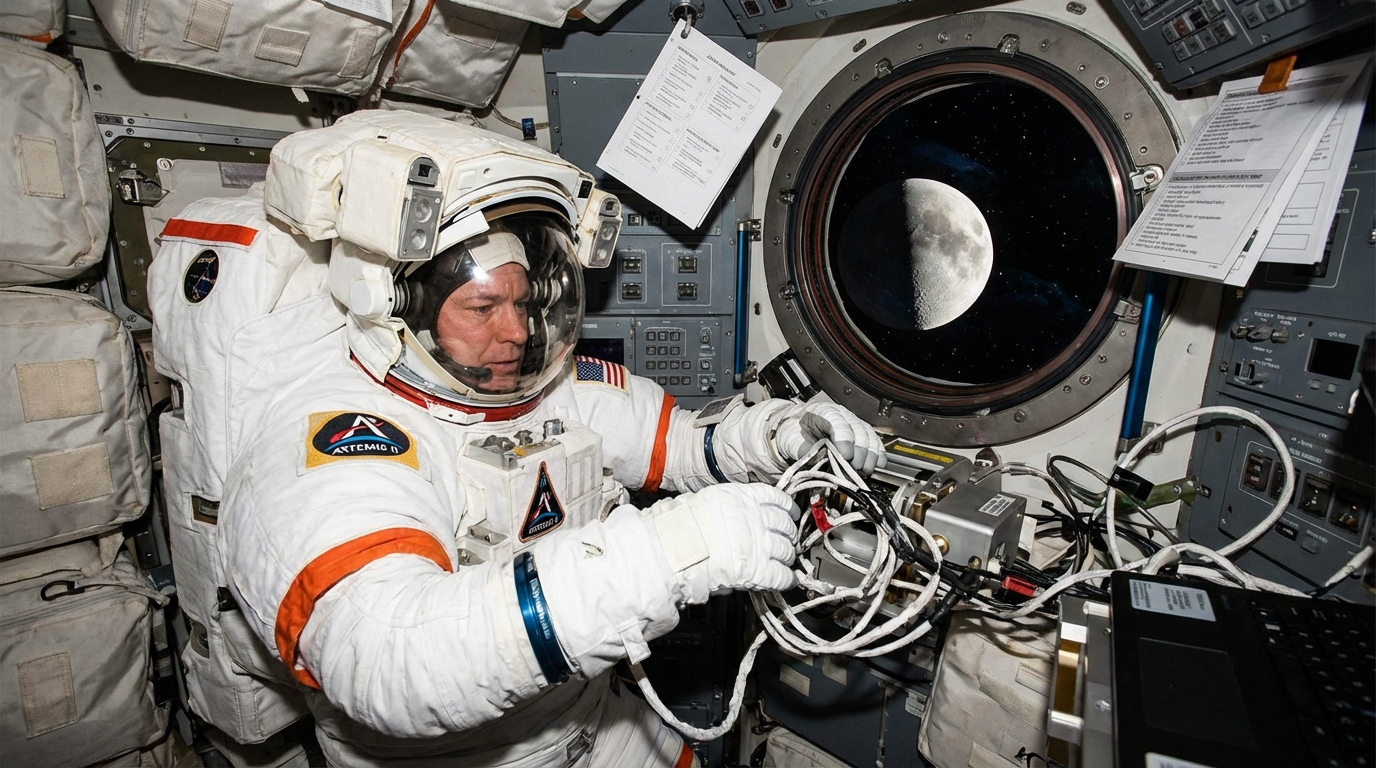
The Artemis II mission is entering a critical phase as astronauts prepare for the highly anticipated moon flyby and subsequent lunar orbit maneuvers on Day 5. This milestone marks a pivotal step in NASA’s efforts to establish a sustainable human presence around the Moon and serves as a significant test of the spacecraft’s capabilities before future lunar landings.
As the first crewed mission to follow Artemis I’s uncrewed test, Artemis II is designed to validate systems essential for crew safety and mission success during the demanding lunar sphere of influence operations. The crew’s activities now focus intensely on maneuvers that will guide the Orion spacecraft through a carefully calculated trajectory for the flyby, setting up the orbital insertion around the Moon. These technical procedures involve precise engine burns, navigation adjustments, and system checks that ensure the spacecraft remains on course and fully operational.
On this crucial day, astronauts have been engaged in rigorous onboard tasks including monitoring telemetry data, performing diagnostics on life support systems, and rehearsing contingency protocols. Their workload also includes aligning navigation instruments and collaborating closely with mission control to update real-time flight parameters. These efforts are critical because the lunar orbit prep phase demands exact timing and coordination to enter the Moon’s gravitational influence safely, all while maintaining Crew health and system integrity.
Behind the scenes, insights from NASA engineers and the astronauts themselves reveal the complexity of these preparations. “Each maneuver is meticulously planned, but we remain ready to adapt to any unforeseen conditions,” said an Artemis II crew member during a recent interview. This readiness to respond dynamically illustrates the mission’s layered complexity. The technical margin for error is minimal, underscoring the importance of training and precision.
The astronauts’ perspective offers a unique window into the day-to-day experience of deep space travel. Managing systems in confined quarters, adapting to microgravity, and maintaining physical and mental health are ongoing challenges. One crewmember described the sensation of approaching the Moon as “both humbling and exhilarating,” emphasizing the blend of scientific rigor and human experience that defines Artemis II.
For readers eager to explore the broader context of Artemis II, previous mission days and technical backgrounds are well documented and provide valuable insights into the mission’s progression. The advances in AI-driven technology showcased in other sectors of space and home technology parallel the sophisticated systems onboard Artemis II. Moreover, innovations in intelligent cooking devices detailed in AI-powered smart ovens demonstrate how automation and real-time data analysis increasingly permeate daily life, much like the critical data processing during spaceflight. For those interested in how connected ecosystems evolve, the integration dynamics outlined in Matter 2.0 smart home integration offer a technological parallel to coordinated systems on spacecraft.
Scientific discussions of Artemis II’s moon flyby highlight strategic mission planning and the scientific objectives of orbiting the lunar far side. According to a detailed overview from Scientific American, this flyby not only proves critical for system validation but also offers opportunities for groundbreaking observations from the lunar surface’s far side, an area never before explored by humans directly in orbit. The meticulous flight day summaries available on NASA’s official blog provide a granular view of trajectory adjustments and system health checks performed up to this point.
As the mission progresses, interviews with astronauts shared by NBC News reveal personal reflections and operational insights that bring the public closer to understanding the human dimension of Artemis II. The blend of mission-critical updates and astronaut experiences enriches public knowledge while fostering greater support for lunar exploration initiatives.
Looking ahead, Artemis II’s upcoming phases will push the Orion spacecraft deeper into lunar orbit, testing the endurance of both the crew and spacecraft systems. These upcoming milestones will be crucial for validating life support, navigation, and communication technologies ahead of Artemis III, which aims to achieve the first crewed lunar landing in this new era of exploration.
Following Artemis II live offers a unique chance to witness space exploration’s next chapter unfold. The blend of intricate technical work and human resilience continues to define this mission. As NASA advances its lunar ambitions, Artemis II stands as a testament to preparation, precision, and pioneering spirit in human spaceflight.
Ready to upgrade every corner of your home? From cozy seating like this Furlide chair to high-tech kitchen gadgets, we’ve got you covered. Check out our Full Library of Home Product Reviews to discover more expert-tested gear for your lifestyle.
[…] While the primary focus is on the Artemis II lunar flyby and its immediate impacts, it’s important to contextualize this within the Artemis program’s broader trajectory. Preparations for subsequent mission phases, such as lunar orbit and potential surface missions, hinge on detailed analyses gathered during this flyby. Technical briefings and mission overviews provide critical context, enhancing public understanding of the spacecraft’s capabilities and the mission’s ambitions.[4] […]
[…] reports complement analysis of the moon flyby and orbit preparations featured in coverage at Artemis II moon flyby lunar orbit prep, which delve deeper into the technical steps necessary for ensuring safety and mission success […]
Trustworthy and transparent. It is hard to find a site these days that actually pays out without any hassle. Five stars! idpercayacuan